
Leadfeeder
B2B visitor identification that names the companies on your site, from Germany
It shows which companies visit your site, what they read and how well they fit your target market, then hands them to your CRM. It is a sales tool more than web analytics: there are no funnels, companies show up minutes after the visit, and full IP addresses are stored unless you shorten them.
- Names visiting companies
- Free Lite plan
- Hosted in the EU
- Paid plans from €79 a month
We make WireBoard, one of the tools we review. It is scored on the same criteria as every other tool. How we review
Who it suits
A good fit if
- You sell to businesses and want to know which companies read your pricing or product pages.
- Your sales team works in a CRM such as HubSpot, Salesforce or Pipedrive and wants visiting companies sent there.
- You want channels and campaigns ranked by the kind of companies they bring, not only by visits.
Look elsewhere if
- You sell to consumers: Leadfeeder reports on companies, not individual people.
- You want general web analytics: there are no funnels, cohorts or user journeys.
- You would rather not store visitor IP addresses: full IPs are kept unless you switch on shortening.
Scores
Below average on features, reporting, pricing, real-time data and privacy.
- Leadfeeder
- Average of the 18 tools we reviewed
Every tool is scored from 0 to 5 on the same seven criteria, and the overall score is their average. How we score
Why these scores
- Ease of use4.0, average 3.8
- One script and the first companies appear within minutes, but defining your ideal customer and building filters takes some learning.
- Design4.0, average 3.9
- Clear company lists and ready-made reports with fit and intent scores on every row.
- Features3.5, average 4.1
- Company identification, visit histories, channel, campaign and page reports with goal conversions, an API and CRM sync, but no funnels or user-level analysis.
- Reporting3.5, average 4.1
- Ready-made reports and filtered company lists, with alerts, CRM sync and AI summaries on the paid plans, but a fixed set of reports.
- Pricing3.0, average 3.6
- Public prices and a free Lite plan, but Lite keeps only 7 days of visitors and paid plans start at €79 a month billed yearly.
- Real-time data2.0, average 3.2
- Leadfeeder says identified companies appear 5 to 10 minutes after a visit, fine for sales follow-up but not a live view.
- Privacy2.0, average 3.2
- Naming the company behind each visit is the point, with a one-year cookie and full IP addresses by default, though a cookieless mode, IP shortening and hosting in Ireland soften it.
Key facts
Data stays in Ireland and a cookieless mode exists, but by default it sets a cookie and keeps full IP addresses, because naming companies is the point.
- What it is
- B2B visitor identification and lead generation, with company-level web reports
- Price
- Free Lite plan. Discover from €79 a month billed yearly (€113 monthly) for up to 50 companies a month
- Free plan
- Lite shows the last 100 companies a month with 7 days of visitor history, without full company details
- Free trial
- 14 days of the full product, no card needed
- Paid unit
- Companies identified a month (once per location, however often they visit), plus credits for contact data
- How it identifies
- Matches each visit's IP address to a company in a database Leadfeeder says holds 45 million IP mappings
- Cookies
- A first-party cookie kept one year by default. A cookieless mode still names companies
- IP addresses
- Stored in full by default. Shortening drops the last part
- Data stored in
- The EU: AWS in Ireland
- Company based in
- Germany (Dealfront Group GmbH, Karlsruhe)
- Freshness
- 5 to 10 minutes after a visit, says the help centre. The pricing page now claims real-time identification on paid plans
- Data kept for
- Unlimited visitor history on paid plans. Web Insights reports keep 2 years, 3 months on Lite
From Leadfeeder’s own site, checked on .
Pricing
Lite is free with no end date. Seeing more than the last week of visitors starts at €79 a month, billed yearly.
Freeon the Lite plan: the last 100 companies a month and 7 days of visitor history
Lite
Last 100 companies a month, 7 days of visitor history, Web Insights reports, 20 credits
Free
Discover
Up to 50 companies a month (€309 for 1,000), full company profiles, alerts, CRM sync, API and MCP access
From €79 a month
Activate
1,000 companies and 200 credits a month, verified emails and phones, display ad campaigns
From €369 a month
Scale
2,000 companies and 1,000 credits a month, yearly billing only, a dedicated success manager
From €599 a month
Enterprise
Custom company and credit volumes
On request
Prices are for yearly billing. Billed monthly, Discover starts at €113 and Activate at €527; Scale is yearly only. Your tier depends on how many companies Leadfeeder identifies each month, and a company that visits several times counts once per location. At the limit, new companies stop appearing until the next billing period.
Our review
What you get
Leadfeeder is not a replacement for Google Analytics. It answers a different question: which companies visited your website? Its script matches each visit's IP address to a company, then shows that company's visits, the pages it read, how well it fits the customer profile you define, and an intent score. Since 24 March 2026 the whole platform is sold as Leadfeeder again. It had been called Dealfront, and the company behind it is still Dealfront Group GmbH in Karlsruhe, Germany, as our news page records.
It has two halves. Web Visitors lists identified companies with their industry, size, location and visit history, and lets you filter them into saved lists. Web Insights is the analytics side: overview, channel, campaign, firmographic and page reports, each row scored for customer fit and intent, with goal conversions. Web Insights shows companies in aggregate; naming them is the job of Web Visitors.
Paid plans add full company profiles, alerts when a target account lands on your site, sync with HubSpot, Salesforce, Pipedrive and other CRMs, Google Ads and LinkedIn Ads reports, an API, and an MCP server for AI assistants. Activate adds verified work emails and phone numbers (paid with credits), CRM automations and display ads aimed at chosen companies. Every plan covers unlimited users and tracked domains.
Who it is for
Leadfeeder is built for B2B companies with a sales team. If a visit to your pricing page from a company in your target market is worth a call, it gives your team names to call. Marketing teams use Web Insights to rank channels and campaigns by the kind of companies they bring, not only by the number of visits.
It works best where visitors browse from company networks, and Leadfeeder says its data is strongest in Europe. Visitors on home or mobile connections usually stay anonymous, because Leadfeeder filters out internet providers, so a site with mostly consumer traffic will see few names.
It is a poor fit if you sell to consumers, if you want funnels and user journeys, or if you would rather not store visitor IP addresses.
Setting it up
You add one script to every page, just above the closing head tag, directly or through Google Tag Manager, WordPress, website builders, or HubSpot and Pardot landing pages. One script covers every site in the account. Then set traffic rules for your hostnames, so test and staging traffic stays out. Every account starts with a 14-day trial of the full product, no card needed.
The help centre gives different timings. One article says the tracker delivers companies 5 to 10 minutes after their visit. Another says new companies can take up to an hour to show after setup, longer on low-traffic sites, and that on the free version data may update the next day. The pricing page now advertises real-time identification on paid plans.
Before going live on an EU site, decide three settings: whether the script waits for your consent manager, whether IP addresses are shortened, and whether to use the cookieless mode. Then define your ideal customer profile and build filters, so the list shows the companies your team cares about rather than every match. A useful first view is the companies in your target market that read your pricing page last week.
Reports and dashboards
The home dashboard charts identified companies, and those matching your ideal customer profile, over recent weeks, next to a list of recently tracked companies with the time of each visit. Web Visitors is where sales works: a feed of companies you can filter by industry, size and location (and on Activate by intent signals), saved as lists the whole team shares. Each company shows its visits, the pages read and the source of each visit.
Web Insights covers the marketing side: overview, channels, campaigns, firmographics and pages, each row with average customer fit, intent score and goal conversions. Lite keeps 3 months of these reports for up to 50,000 unique visitors a month; paid plans keep 2 years. From Discover, AI summaries explain changes in a report, you can ask questions in plain English, and Google Ads and LinkedIn Ads reports show which campaigns bring target companies.
Alerts tell a salesperson when a chosen account visits, and CRM sync sends companies to HubSpot, Salesforce or Pipedrive. What you will not find is a funnel report, cohorts or per-person journeys: the reports are a fixed set, and they describe companies, not people.
Privacy and your data
Identifying visitors is the product, so privacy works differently here. By default the script sets a first-party cookie, _lfa, for one year, and records the IP address, the pages viewed, visit time and length, and the traffic source and campaign. Form submissions, file downloads and outbound clicks are collected only when you switch that tracking on. Leadfeeder says the script sets no third-party cookies.
Full IP addresses are stored unless you switch on IP anonymisation, which keeps a shortened address: 212.50.143.138 becomes 212.50.143.0. With cookies off, Leadfeeder still names companies but cannot recognise returning visitors, so one visit can appear as several short ones. With consent manager support on, a second cookie stores the visitor's choice for 2 years.
Data is hosted on Amazon Web Services in Ireland, and Leadfeeder says it holds ISO 27001 and ISO 27701 certificates. For the tracking script you are the controller and Leadfeeder your processor, under a data processing agreement that applies automatically. Leadfeeder says whether you need consent depends on the laws that apply to you, and that the assessment is yours to make. Its contact database is built from public sources and vetted data providers, on the basis of legitimate interest. Visitor history has no time limit on paid plans; Lite shows the last 7 days.
Pricing in practice
Leadfeeder prices in euros by companies identified a month. A company counts once a month per location, however often it visits, and internet providers are filtered out. The prices below are per month, billed yearly; monthly billing costs more, since paying yearly saves 30%.
A small consultancy that sees 40 target companies a month pays €79 on Discover (€113 billed monthly). At 300 companies the price is €179 (€256), and at 1,000 it is €309 (€441). If sales also wants verified emails and phone numbers, Activate starts at €369 (€527) for 1,000 companies and 200 credits a month. Scale, from €599 for 2,000 companies and 1,000 credits, is billed yearly only, and Enterprise is quoted.
Identifying companies uses no credits; contact data and enrichment do. When you reach your plan's limit, the help centre says new visiting companies stop appearing in the feed until the next billing period, so pick a tier with room for busy months. Lite, the free plan, has no end date but shows only the last 100 companies, with 7 days of history. Our pricing comparison covers the analytics tools it is often weighed against.
Alternatives to Leadfeeder
Leadfeeder names companies; most tools in our reviews count visits or follow people. Which one fits depends on what you need next to, or instead of, company identification.
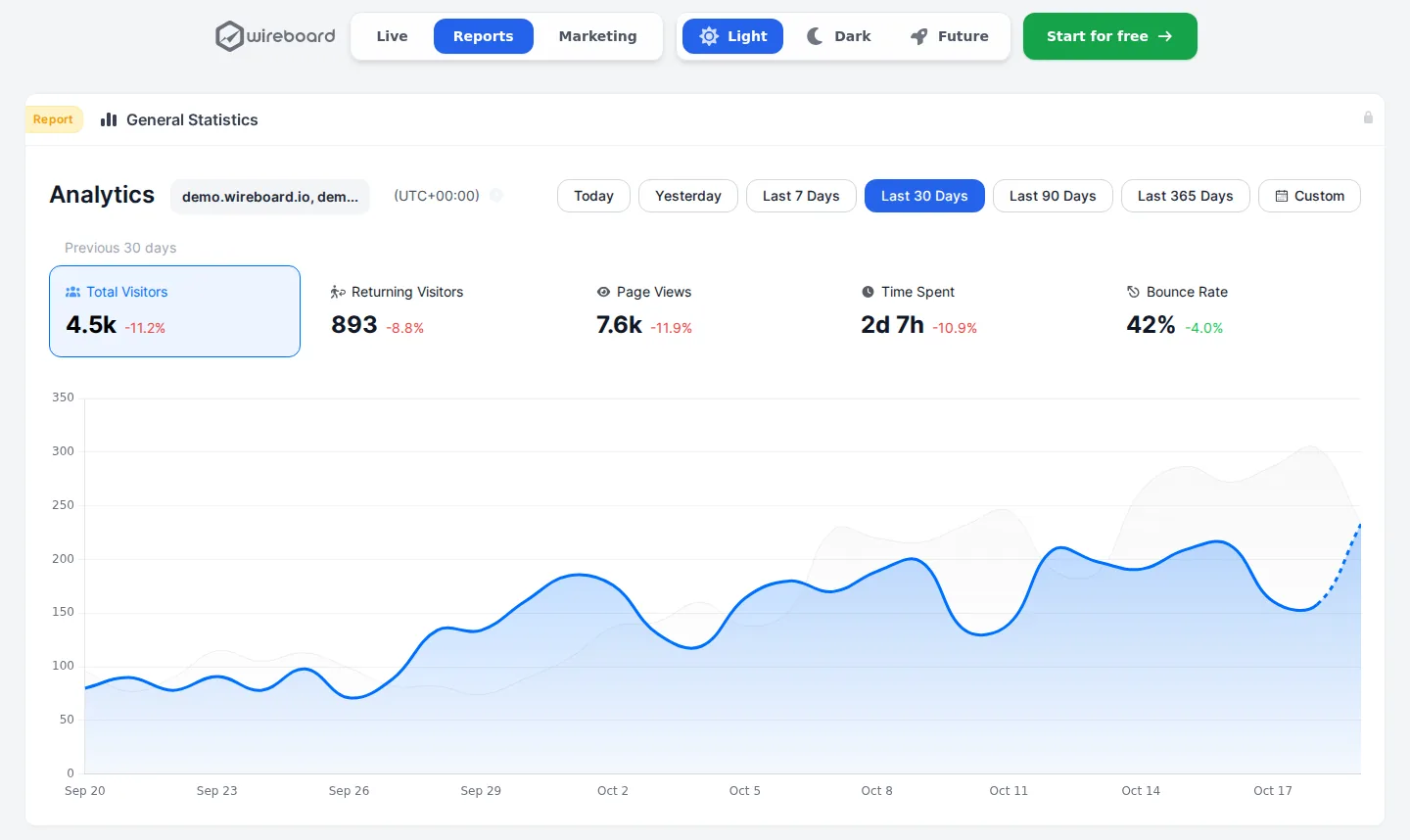
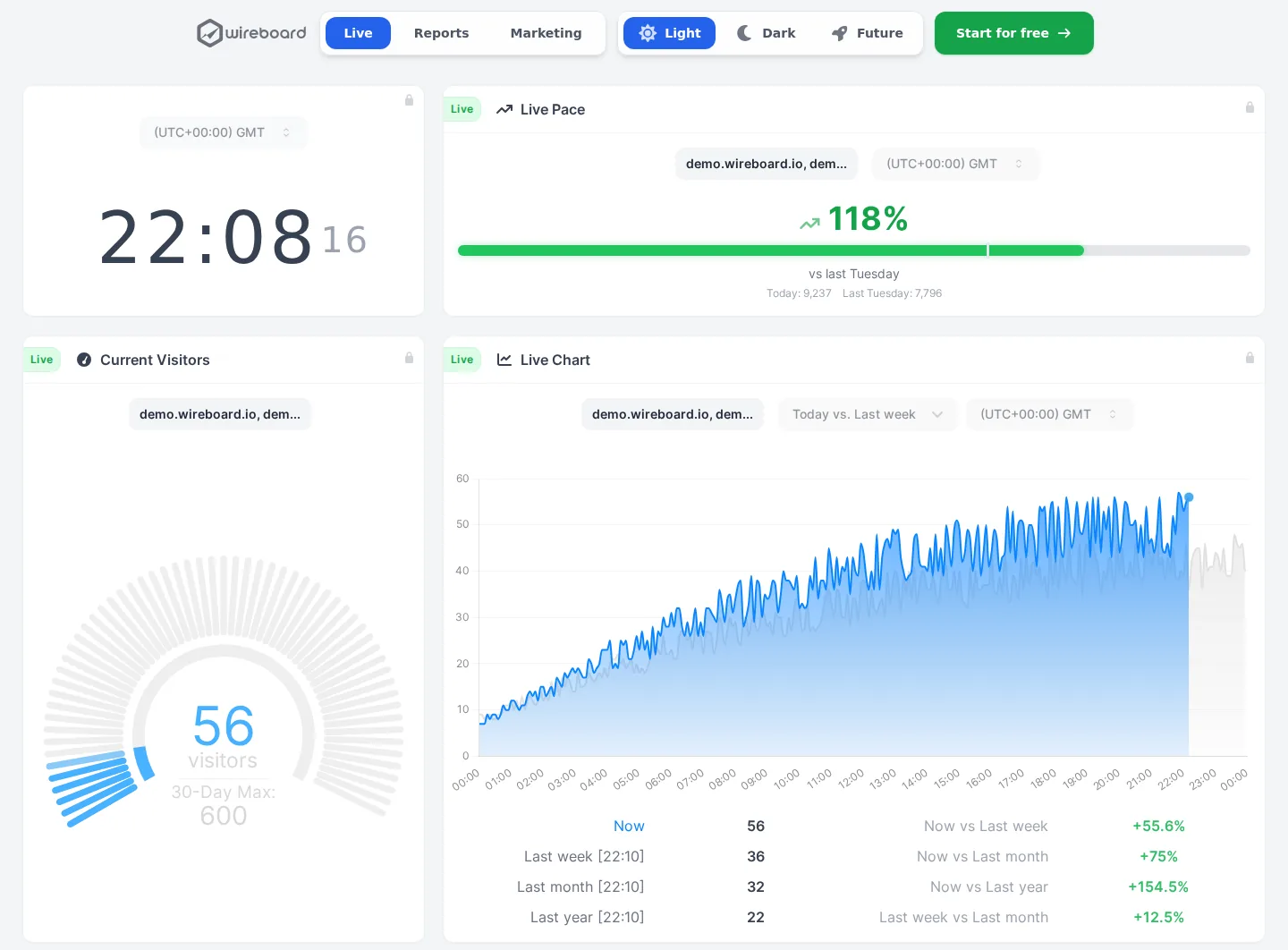
WireBoard (made by us) adds a live view next to company identification. Its widgets stream visitors, pages, sources and events within seconds across several sites, with a free plan for 50,000 pageviews a month on 2 sites and data hosted in the EU. It covers the traffic side, so it works alongside Leadfeeder.
Google Analytics is the free traffic tool many Leadfeeder customers already run. It covers sources, campaigns, funnels and ecommerce, but names no companies, sets cookies that generally need consent in the EU, and takes 24 to 48 hours to process data.
Matomo suits a team that wants full analytics with EU hosting or on its own server: the cloud is hosted in Frankfurt and starts at $26 a month, and self-hosting is free. Like Google Analytics, it reports visits, not companies.
Heap and Mixpanel suit a SaaS business that wants account-level analysis inside product analytics. Heap includes account analytics on its quote-only Pro plan, and Mixpanel sells group analytics, which counts companies instead of people, as a paid add-on.
Woopra builds a profile for every person and triggers actions in your other tools, from $999 a month, with data in the US.
Where it falls short
As web analytics it is thin: no funnels, no cohorts and no user-level analysis, and the Web Insights reports are a fixed set. It names companies, not people, and only those it can match; visitors on home or mobile connections usually stay anonymous.
The free Lite plan is narrow for lead generation: the last 100 companies a month and 7 days of history, without full company details. Real use starts at €79 a month billed yearly (€113 monthly) for just 50 companies a month, a company with several offices can count more than once, and contact data costs credits on top.
Freshness is unclear. The pricing page promises real-time identification on paid plans, while the help centre says 5 to 10 minutes after a visit, or up to an hour after setup. And the default setup, a year-long cookie plus full IP addresses, needs a careful look before it goes on an EU site.
How it compares
Google Analytics and Matomo count visits, while Leadfeeder names the companies behind them. Heap and Mixpanel offer account-level analysis, on a quote-only plan or as a paid add-on.
- Free plan
- Up to 50k pageviews
- Cookieless
- Optional
- Open source
- No
- EU hosting
- Yes
- Free plan
- Up to 1M events a month
- Cookieless
- No
- Open source
- No
- EU hosting
- Your choice
- Free plan
- Self-hosted only
- Cookieless
- Optional
- Open source
- Yes
- EU hosting
- Yes
- Free plan
- Yes
- Cookieless
- No
- Open source
- No
- EU hosting
- No
- Free plan
- Up to 10k sessions a month
- Cookieless
- No
- Open source
- No
- EU hosting
- Your choice
Leadfeeder (this review)
Starts at Free
3.1out of 5
- Free plan
- Yes, 7 days of history
- Cookieless
- Optional
- Open source
- No
- EU hosting
- Yes
- Free plan
- No
- Cookieless
- No
- Open source
- No
- EU hosting
- No





Made by us

WireBoard
See your traffic as it happens, on live dashboards you build yourself. Nearly every feature is on the free plan.
- Visitors, sources and events streamed live
- Several sites in one view, on 60+ widgets
- Events, goals, funnels and revenue on every plan
- Free for 2 sites, $9 a month for 50
- Data processed in Germany and Finland
Questions
What is Leadfeeder used for?
It tells B2B sales and marketing teams which companies visit their website. It matches each visit's IP address to a company, shows the pages that company read, scores how well it fits your target market and how interested it seems, and can push it to your CRM. By default it reports companies, not individual people.
Is Leadfeeder the same as Dealfront?
Yes. The platform was sold as Dealfront until 24 March 2026, when it took the Leadfeeder name, and dealfront.com now leads to leadfeeder.com. The visitor feed once called Leadfeeder is now named Web Visitors. Contracts stay with Dealfront Group GmbH and its affiliates.
Is Leadfeeder free?
Yes. Lite is free with no end date. It shows the last 100 companies a month with 7 days of visitor history, plus Web Insights reports with 3 months of history for up to 50,000 unique visitors a month. Every account starts with a 14-day trial of the full product, no card needed.
How much does Leadfeeder cost?
Lite is free. Discover starts at €79 a month billed yearly (€113 monthly) for up to 50 identified companies a month, and costs €309 (€441) for 1,000. Activate, with verified contact data, starts at €369 (€527) for 1,000 companies and 200 credits. Scale starts at €599, billed yearly only, and Enterprise is quoted.
What happens when I reach my company limit?
Leadfeeder's help centre says additional visiting companies will not appear in your feed until the next billing period. Identifying companies uses no credits, so there is no extra charge; you can upgrade or ask support for a higher limit. A company counts once a month per location, so one with several offices can count more than once.
Does Leadfeeder need a cookie banner?
It depends on your setup and the law where you operate. By default the script sets a one-year cookie and records the visitor's IP address and the pages viewed. Leadfeeder supports consent managers, a cookieless mode that still names companies but cannot spot returning visitors, and IP shortening. It says the assessment is yours to make.
How accurate is Leadfeeder?
Leadfeeder says it matches visits against more than 45 million IP mappings covering about 9 million companies, refreshed daily and strongest in Europe. It filters out internet providers and low-quality traffic, so visits it cannot tie to a company stay anonymous. Running the 14-day trial on your own traffic shows how many of your visits it can name.
Can Leadfeeder replace Google Analytics?
No. Its Web Insights reports cover channels, campaigns, pages and goal conversions, but they describe companies in aggregate and come as a fixed set, with no funnels, cohorts or user journeys. Most teams run Leadfeeder next to a traffic analytics tool such as Google Analytics or Matomo, and use it to see which companies are behind the visits.
About this review
First published on . Facts and prices checked on against Leadfeeder’s own site.
Analytics Alternative is run by SwissOps, which also makes WireBoard, one of the tools on this site. WireBoard is scored on the same seven criteria as every other tool. How we review
Where the facts come from:
- leadfeeder.com/pricing
- leadfeeder.com/web-insights
- leadfeeder.com/web-insights/free
- leadfeeder.com/web-visitors/free
- leadfeeder.com/product-updates/dealfront-is-rebranding-as-leadfeeder-faq
- leadfeeder.com/gdpr
- leadfeeder.com/security
- leadfeeder.com/privacy/privacy-notice
- help.leadfeeder.com/en/articles/13922333-web-visitors-tracking-script-data-processing-roles
- help.leadfeeder.com/en/articles/13922296-what-is-the-web-visitors-tracking-script
- help.leadfeeder.com/en/articles/13922429-maximizing-leadfeeder-with-web-visitors-identification-tool
- help.leadfeeder.com/en/articles/13922369-what-is-considered-an-identified-company
Spotted something out of date? Tell us.