
Pirsch Analytics
Cookie-free web analytics, made and hosted in Germany
A cookieless dashboard hosted in Germany that starts at $6 a month for 50 sites and keeps your data with no time limit. There is no free plan, funnels and A/B tests need the dearer Plus plan, and the dashboard itself is closed source.
- From $6 a month
- No cookies
- Hosted in Germany
- Data kept with no time limit
We make WireBoard, one of the tools we review. It is scored on the same criteria as every other tool. How we review
Who it suits
A good fit if
- You run several small sites on a small budget: Standard covers 50 sites from $6 a month.
- You want analytics without cookies, with the data stored in Germany.
- You want to keep your history for good, whatever plan you are on.
Look elsewhere if
- You need funnels, A/B tests or revenue on the cheapest plan: they come with Plus, at two to three times the price.
- You want a free plan: there is only a 30-day trial.
- You want to host it yourself: that needs an Enterprise licence.
Scores
Above average on privacy, pricing and ease of use.
- Pirsch Analytics
- Average of the 18 tools we reviewed
Every tool is scored from 0 to 5 on the same seven criteria, and the overall score is their average. How we score
Why these scores
- Privacy4.5, average 3.2
- No cookies, a daily hash in place of the IP address, and servers in Germany. Only the counting library and client tools are open source.
- Pricing4.5, average 3.6
- $6 a month for 10,000 pageviews on 50 sites, with unlimited members and no limit on data retention.
- Ease of use4.5, average 3.8
- One script tag and a clear dashboard, with more panels and settings to learn than the simplest tools.
- Design4.0, average 3.9
- Clean and quick, with a dark mode. Custom themes and white labelling come with Plus, but there are no custom dashboards.
- Features4.0, average 4.1
- Events, goals, session analysis, Search Console data, webhooks and an API on Standard. Funnels, A/B tests, segments and revenue need Plus.
- Reporting4.0, average 4.1
- Combined filters, saved views, period comparisons, email reports, CSV exports and an API on every plan, with tag-based segments on Plus.
- Real-time data3.0, average 3.2
- A live period and an active visitors count with their pages, both refreshed every 30 seconds.
Key facts
No cookies, servers in Germany and no limit on how long data is kept. The gaps: no free plan, and the dashboard is closed source.
- Price
- From $6 a month for 10,000 pageviews on up to 50 sites
- Free plan
- None
- Free trial
- 30 days or 100,000 pageviews from your first site, no card
- Cookies
- None: a daily hash of IP address and browser, the IP is not stored
- Open source
- Partly. The core library is AGPL v3, the dashboard is closed
- Self-hosting
- Only with an Enterprise licence
- Data stored in
- Germany, on Hetzner servers
- Company based in
- Germany
- Live view
- Active visitors and their pages, refreshed every 30 seconds
- Data kept for
- No time limit, on every plan
- Team members
- Unlimited on every plan
- Billing
- Monthly, or yearly with 2 months free
From Pirsch Analytics’s own site, checked on .
Pricing
$6 a month covers 50 sites. Funnels and A/B tests on Plus cost two to three times as much.
$6a month to start, for 10,000 pageviews on up to 50 sites
| Pageviews a month | Relative price | Monthly | Yearly |
|---|---|---|---|
| 10k | $6 | $60 | |
| 100k | $12 | $120 | |
| 200k | $18 | $180 | |
| 500k | $36 | $360 | |
| 1M | $54 | $540 | |
| 5M | $99 | $990 | |
| 10M | $159 | $1,590 | |
| 20M | $249 | $2,490 | |
| 50M | $499 | $4,990 | |
| 100M | $799 | $7,990 |
Yearly billing costs ten months for twelve. Custom events (outbound clicks, downloads and 404 events included), and 10% of session extension events, count toward the pageview limit. Prices exclude VAT. Above 100 million pageviews, or for hosting on your own servers, Pirsch quotes a price.
Compare Pirsch Analytics’s prices with other tools on compare-analytics.com (opens in a new tab)
Our review
What you get
Pirsch is a hosted, cookieless analytics service from Emvi Software GmbH, a company founded in 2019 in Rheda-Wiedenbrück, Germany. It counts unique visitors, pageviews, sessions, bounce rate, session duration and time on page, and splits them into panels: pages, entry and exit pages, referrers, channels, UTM campaigns, countries, regions and cities, languages, browsers, operating systems, devices and screen sizes. Channels follow the definitions of Google Analytics 4, and an AI channel groups visits sent by services such as OpenAI and Perplexity.
The Standard plan also covers custom events with metadata, conversion goals with targets, sessions that show the pages and events of single visits, a Search Console panel with the keywords that bring people in, traffic alerts, scheduled email reports, CSV export and an API with official SDKs. A built-in link shortener counts clicks on the links you share.
Plus adds funnels of up to eight steps, tags for A/B tests and segments, ecommerce revenue and other custom metrics, Teams to group dashboards, a custom domain, custom themes and white labelling for agencies that show dashboards to clients. Enterprise, priced on request, adds single sign-on, raw data access and hosting on your own servers or a managed cloud.
Who it is for
Pirsch suits people who run several small or mid-sized sites and want them counted without cookies, for little money. Standard covers 50 sites from $6 a month, so a freelancer with a dozen client sites, or a company with a blog, a shop and a docs site, pays once. It also suits developers: the server-side API lets a site send visits from its backend, where no ad blocker can stop them, and official SDKs cover JavaScript, Go and PHP.
History matters too. Pirsch keeps your data with no time limit on every plan, where many rivals stop at a few years.
Look elsewhere if you want a free plan, or funnels and A/B tests on the cheapest tier. The same goes if you want open-source code for the whole product, or to host the tool yourself, which needs an Enterprise licence. And it is not a tool for watching traffic second by second.
Setting it up
You create a dashboard by entering your site's hostname and time zone, then paste one script tag into the page head. The script weighs about 3.5 KB compressed and follows page changes in single-page apps by default. Pirsch says setting up the first site "only takes a few minutes", and visits show within seconds.
There are other ways in. The WordPress plugin works from your server without JavaScript, with an optional snippet for events. Step-by-step guides cover Framer, Webflow, Shopify and Google Tag Manager, and community plugins exist for Laravel, Caddy and others. Pirsch calls server-side tracking through its API "the recommended way", because the browser cannot block it. To keep the script from being blocked, you can run Pirsch's open-source proxy, or use a custom domain on Plus.
The trial lasts 30 days or 100,000 pageviews, whichever comes first, needs no card, and starts when you add your first site.
If you are leaving Google Analytics, Pirsch can import your history. Its import page still describes Universal Analytics, but its changelog announced a GA4 import in 2024, and Pirsch says on its forum that the importer supports GA4 only. It also imports from Plausible and Fathom. Imported data is stored as daily totals, so filters switch off when results include it, those days have no hourly figures, and GA4 imports have no exit pages. You can only import data up to the day you created the dashboard.
Reports and dashboards
Everything sits on one dashboard per site. Click any entry to filter by it, combine filters, invert them or match with "contains", and save a set of filters as a view. Periods run from the last hour to all time, and you can compare with the previous period, the same period last year or custom dates.
Events are sent with a JavaScript call, CSS classes, HTML attributes or the API, each with up to 20 metadata fields. Outbound link clicks and file downloads are recorded as events automatically, and 404 pages with one line of code. A conversion goal matches a path or an event, with an optional target that emails you when it is reached.
Funnels (Plus) take up to eight steps and show the drop-off and conversion rate at each one. Tags (Plus) mark visits for A/B tests or segments. Tags sent from a Standard account are dropped.
The live view covers the last 10 minutes by default, with active visitors and their pages, and the dashboard refreshes it every 30 seconds. A live map and a count of active visitors in the browser tab are also available.
Email reports go out daily, weekly, every two or three weeks, or monthly, to you or to clients, with the sections you pick. You can make a dashboard public, share it with an access link that expires, or embed it in a page. Alerts warn you of traffic spikes and of days with no traffic at all.
Exports are CSV files of aggregated statistics, from the settings or the API. Pirsch offers raw data exports on request, and raw data access on Enterprise.
Privacy and your data
Pirsch says "We do not use cookies". It recognises a visit with a hash of the IP address, the browser's user agent, the date and a salt that differs per site, so a visitor cannot be recognised for more than 24 hours or matched across sites. Pirsch says the IP address is "never stored or logged", and its homepage says it works without consent banners.
The company is German, and its privacy policy says your data "will only be stored on servers in Germany", at Hetzner. The same policy names a short list of other services for email, payments and accounts. A data processing agreement is available in English and German.
The core library that does the counting is open source under AGPL v3, so you can check how visitors are counted, and the SDKs, proxies and WordPress plugin are MIT licensed. The dashboard and the service are closed, and running Pirsch on your own servers needs an Enterprise licence.
Data is kept with no time limit on every plan, and you can delete all or part of it from the settings.
Pricing in practice
Pirsch prices by monthly pageviews. Custom events count toward the same limit, and so do outbound clicks, downloads and 404 events, plus 10% of session extension events. Prices exclude VAT, and yearly billing costs ten months for twelve.
A small blog with 8,000 pageviews a month pays $6 a month on Standard, or $60 a year. A second and third blog on the same account cost nothing extra, as long as the total stays under 10,000.
A growing shop with 150,000 pageviews and events a month needs the 200,000 level: $18 a month on Standard. If it wants funnels and revenue, Plus costs $45 a month, or $450 a year.
An agency with 40 client sites and 800,000 pageviews between them pays $54 a month on Standard for 1 million. White labelling, custom domains and Teams need Plus, at $159 a month, which also lifts the 50-site cap.
At the limit, the dashboard stops at the day you reached it. Pirsch keeps collecting for five more days, then stops accepting pageviews until you upgrade or the limit resets with your next monthly cycle, so waiting leaves a gap. Our pricing comparison sets these figures against other tools.
Alternatives to Pirsch
WireBoard (made by us) fits if you run many sites and want them added up in one live view. Its free plan covers 2 sites, and $9 a month covers 100,000 pageviews on 50 sites, $3 less than Pirsch's Standard at that level. Live widgets update within seconds, and funnels and revenue are on every plan. It sets cookies by default, with an optional cookieless mode.
Plausible is open source, with a free self-hosted edition and EU hosting, from $9 a month for one site. Funnels come with its Business plan.
Umami is cookieless and open source, with a free cloud plan for 100,000 events on one site that includes funnels and retention.
Fathom also covers 50 sites on every plan, from $15 a month for 100,000 pageviews, but stores data in the US and has no funnels.
Our lists of free plans and open-source tools have more options.
Where it falls short
There is no free plan. Funnels, A/B tests, segments and revenue are Plus features, and Plus costs two to three times as much as Standard for the same traffic: $27 against $12 at 100,000 pageviews.
The live view refreshes every 30 seconds, which is fine on launch day but not for second-by-second monitoring. Custom events count toward your pageview limit, so sites that track many events move up a tier sooner, and going over can leave a gap in your data.
The vendor's pages do not always agree. The pricing table lists webhooks on Standard while the webhook docs call them a Plus feature, and the Google Analytics import page still talks about Universal Analytics. Imported history comes in as daily totals you cannot filter.
Pirsch runs on your own servers only with an Enterprise licence, because the open-source part is the counting library, not the dashboard. And there are no custom dashboards: every site gets the same layout.
How it compares
From 10,000 to 1 million pageviews it costs less than Plausible or Fathom and covers 50 sites, but Simple Analytics and Umami have free plans, and Plausible and Umami are open source with free self-hosted editions.
- Free plan
- Up to 50k pageviews
- Cookieless
- Optional
- Open source
- No
- EU hosting
- Yes
- Free plan
- Up to 100k events
- Cookieless
- Yes
- Open source
- Yes
- EU hosting
- Your choice
Pirsch Analytics (this review)
Starts at $6 a month
4.1out of 5
- Free plan
- No
- Cookieless
- Yes
- Open source
- Partly
- EU hosting
- Yes
- Free plan
- Self-hosted only
- Cookieless
- Yes
- Open source
- Yes
- EU hosting
- Yes
- Free plan
- Self-hosted only
- Cookieless
- Optional
- Open source
- Yes
- EU hosting
- Yes
- Free plan
- 5 sites, 30 days of data
- Cookieless
- Yes
- Open source
- No
- EU hosting
- Yes
- Free plan
- No
- Cookieless
- Yes
- Open source
- No
- EU hosting
- No





Made by us

WireBoard
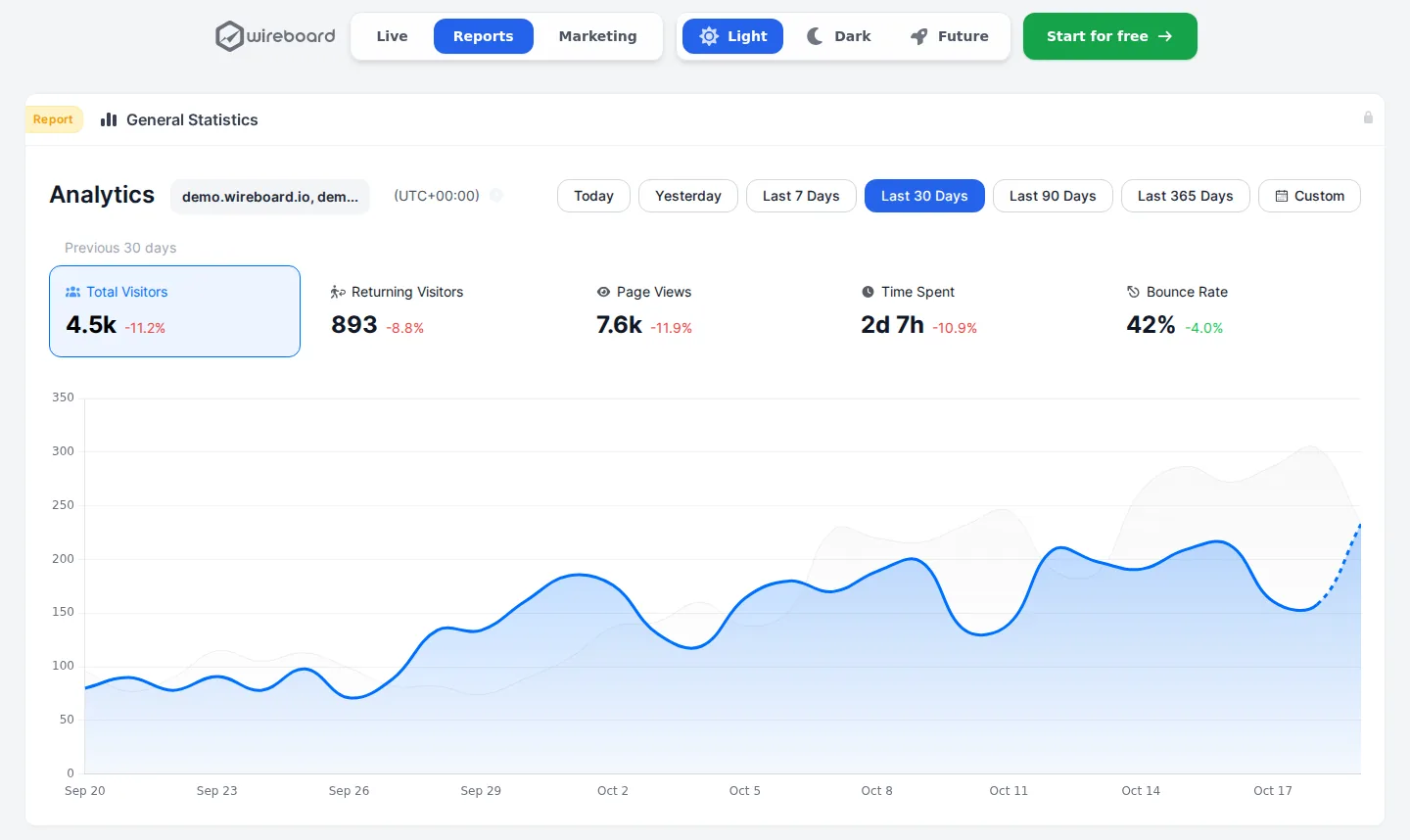
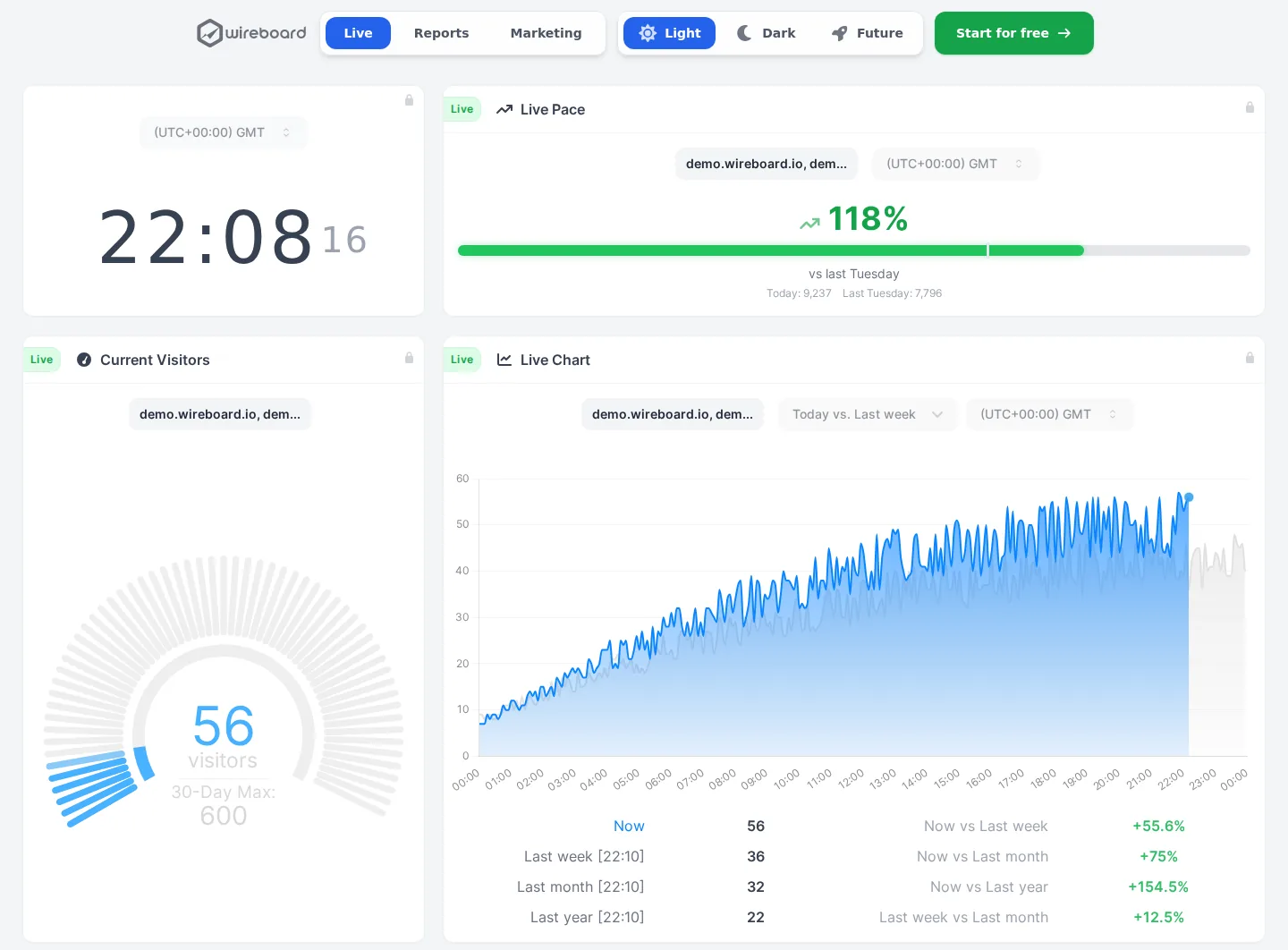
See your traffic as it happens, on live dashboards you build yourself. Nearly every feature is on the free plan.
- Visitors, sources and events streamed live
- Several sites in one view, on 60+ widgets
- Events, goals, funnels and revenue on every plan
- Free for 2 sites, $9 a month for 50
- Data processed in Germany and Finland
Questions
Does Pirsch need a cookie banner?
Pirsch sets no cookies and does not store IP addresses. It recognises visitors with a hash that changes every day, so nobody can be followed for more than 24 hours, and its homepage says it works without consent banners. Whether your site needs a banner also depends on everything else it loads, and on the law where you operate.
Is Pirsch free?
No. There is no free plan, only a trial of 30 days or 100,000 pageviews, whichever comes first, with no card. The trial starts when you add your first site. After that, Standard starts at $6 a month for 10,000 pageviews on up to 50 sites, or $60 a year, excluding VAT.
What happens if I go over my pageview limit?
Pirsch keeps collecting data for five more days, but your dashboard stops at the day you reached the limit. Upgrade within those five days to avoid a gap, or wait for the limit to reset with your next billing cycle. Custom events count toward the limit too, and Pirsch can email you when usage reaches a share you choose.
Can I host Pirsch myself?
Only with an Enterprise licence, priced on request, which Pirsch suggests for larger companies. The core library that does the counting is open source under AGPL v3, and its SDKs and proxies are MIT licensed, but the dashboard and the service around it are not. Plausible and Umami both offer a free self-hosted edition.
Can I import Google Analytics data into Pirsch?
Yes. You connect your Google account in the settings and pick the property and dates. Pirsch says the importer supports GA4, although its import page still mentions Universal Analytics. It also imports from Plausible and Fathom. Imported data arrives as daily totals: filters do not work on it, and you can only import up to the day you created the dashboard.
Where is Pirsch's data stored?
On Hetzner servers in Germany. Pirsch's privacy policy says your data "will only be stored on servers in Germany", and the company behind it, Emvi Software GmbH, is based in Rheda-Wiedenbrück, Germany. A data processing agreement is available in English and German, and data is kept with no time limit unless you delete it.
Does Pirsch have funnels?
On the Plus plan only. A funnel takes up to eight steps, each made of one or more filters, and shows the drop-off and conversion rate at every step. You define funnels in advance, in the dashboard or through the API. Plus starts at $12 a month for 10,000 pageviews, twice the price of Standard.
Pirsch or Plausible?
Both are cookieless and store data in the EU. Plausible is open source and has a free self-hosted edition. Pirsch costs less at the low end, $6 against $9 for 10,000 pageviews, and its cheapest plan covers 50 sites where Plausible's covers one. Pirsch also keeps data with no time limit, where Plausible's Starter plan keeps 3 years.
About this review
First published on . Facts and prices checked on against Pirsch Analytics’s own site.
Analytics Alternative is run by SwissOps, which also makes WireBoard, one of the tools on this site. WireBoard is scored on the same seven criteria as every other tool. How we review
Where the facts come from:
- pirsch.io/pricing
- pirsch.io/features
- pirsch.io/privacy
- docs.pirsch.io/privacy
- docs.pirsch.io/advanced/funnels
- docs.pirsch.io/advanced/segmentation-tags
- docs.pirsch.io/get-started/ga-import
- github.com/pirsch-analytics/pirsch
- pirsch.io/legal
- docs.pirsch.io/billing
- docs.pirsch.io/faq
- docs.pirsch.io/advanced/events
- docs.pirsch.io/advanced/email-reports
- docs.pirsch.io/advanced/webhooks
- docs.pirsch.io/get-started/backend-integration
- pirsch.io/about-us
- forum.pirsch.io/t/import-historical-data-from-google-analytics-4/152
Spotted something out of date? Tell us.