Google Analytics alternative guide 2026
Why people leave Google Analytics, which alternative fits your kind of site, and how to switch without losing your history. Every tool here was re-reviewed in October 2026 against one published method.
Updated on , a 17 minute read. We make WireBoard, one of the tools in this guide. How we review


Why people look for an alternative to Google Analytics
Google Analytics is free and deep, with funnels, cohorts, ecommerce reports and a BigQuery export. People look elsewhere for a few concrete reasons.
Google Analytics 4 replaced the version they knew. Standard Universal Analytics properties stopped processing data on 1 July 2023, and from the week of 1 July 2024 Google removed access to them and to their API. GA4 records everything as events, with new reports and a new vocabulary.
It takes real learning. Anything past the standard reports means Explorations, custom dimensions or BigQuery. Google says processing takes 24 to 48 hours, so yesterday's numbers can still move.
Detailed history is short. In a standard property, the event-level data behind Explorations and funnel reports is kept for 2 or 14 months, and a new property starts at 2. Standard reports are not affected, but a new exploration cannot reach back past that limit.
Small numbers are hidden. When a report includes demographics or search queries, Google withholds rows with too few users, so that no one can infer who a visitor is. You cannot adjust these thresholds.
Consent banners leave gaps. The Google tag sets two cookies kept for 2 years, so in the EU it generally needs consent. Consent mode is Google's answer: it passes each visitor's choice to Google's tags. In its advanced setup, the tags send cookieless pings when a visitor refuses, and Google fills the gap with modelling. But Google lists minimums for modelling: at least 1,000 events a day from visitors who refused, for 7 days, and 1,000 daily users who accepted, on at least 7 of the last 28 days. Below that, the visitors who say no are simply missing.
Transfers to the US worried European regulators. In 2022, after complaints that followed the EU Court of Justice's Schrems II ruling, France's CNIL, working with other European authorities, ordered several organisations to stop using Google Analytics because of how their data reached the United States. On 10 July 2023 the European Commission adopted an adequacy decision for the EU-US Data Privacy Framework: personal data can now flow freely to US companies that take part in it, and Google says Google LLC has certified. In September 2025 the EU General Court dismissed an action to annul that decision. The Court of Justice struck down the two frameworks before it, and the Commission must keep monitoring this one. This is not legal advice: check your own case with your adviser.
All 18 tools, ranked
Scores are the average of seven criteria. Click a name for the full review.















- Free plan
- Up to 50k pageviews
- Cookieless
- Optional
- Open source
- No
- EU hosting
- Yes
- Free plan
- Up to 100k events
- Cookieless
- Yes
- Open source
- Yes
- EU hosting
- Your choice
- Free plan
- No
- Cookieless
- Yes
- Open source
- Partly
- EU hosting
- Yes
- Free plan
- Up to 1M events a month
- Cookieless
- No
- Open source
- No
- EU hosting
- Your choice
- Free plan
- Self-hosted only
- Cookieless
- Yes
- Open source
- Yes
- EU hosting
- Yes
- Free plan
- Up to 3,000 pageviews a day
- Cookieless
- Yes
- Open source
- No
- EU hosting
- No
- Free plan
- Self-hosted only
- Cookieless
- Optional
- Open source
- Yes
- EU hosting
- Yes
- Free plan
- Yes, without recordings
- Cookieless
- No
- Open source
- No
- EU hosting
- No
- Free plan
- Up to 50k pageviews
- Cookieless
- Yes
- Open source
- No
- EU hosting
- Yes
- Free plan
- 5 sites, 30 days of data
- Cookieless
- Yes
- Open source
- No
- EU hosting
- Yes
- Free plan
- No
- Cookieless
- Yes
- Open source
- No
- EU hosting
- No
- Free plan
- Yes
- Cookieless
- No
- Open source
- No
- EU hosting
- No
- Free plan
- First 1M events only
- Cookieless
- Yes
- Open source
- No
- EU hosting
- Yes
- Free plan
- Up to 10k sessions a month
- Cookieless
- No
- Open source
- No
- EU hosting
- Your choice
- Free plan
- Up to 200k sessions
- Cookieless
- Optional
- Open source
- No
- EU hosting
- Yes
- Free plan
- No
- Cookieless
- No
- Open source
- No
- EU hosting
- No
- Free plan
- Yes, 7 days of history
- Cookieless
- Optional
- Open source
- No
- EU hosting
- Yes
- Free plan
- No
- Cookieless
- No
- Open source
- No
- EU hosting
- No
Hotjar moved into Contentsquare and Smartlook is shutting down: what changed among these tools this year is in our news.
Made by us

WireBoard
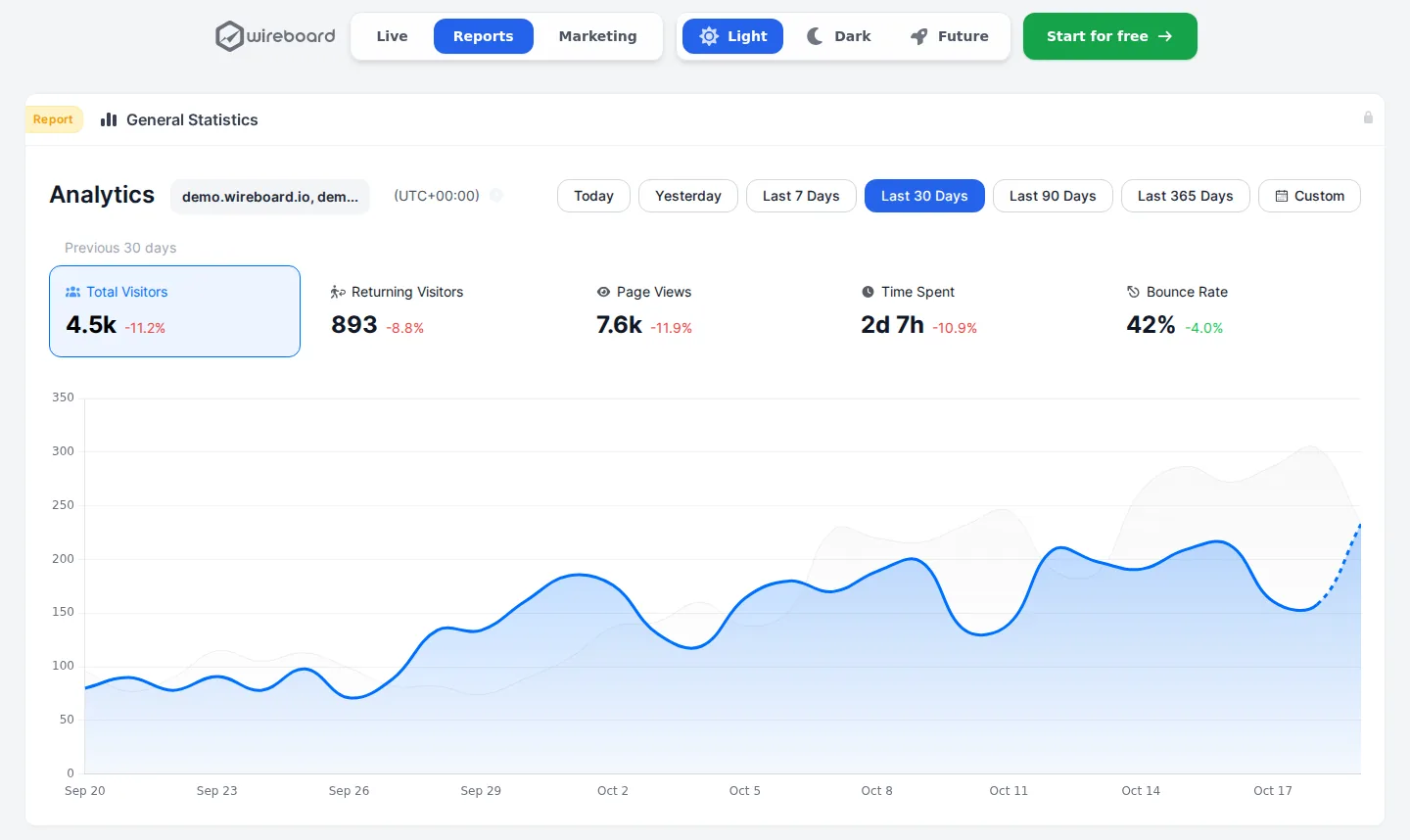
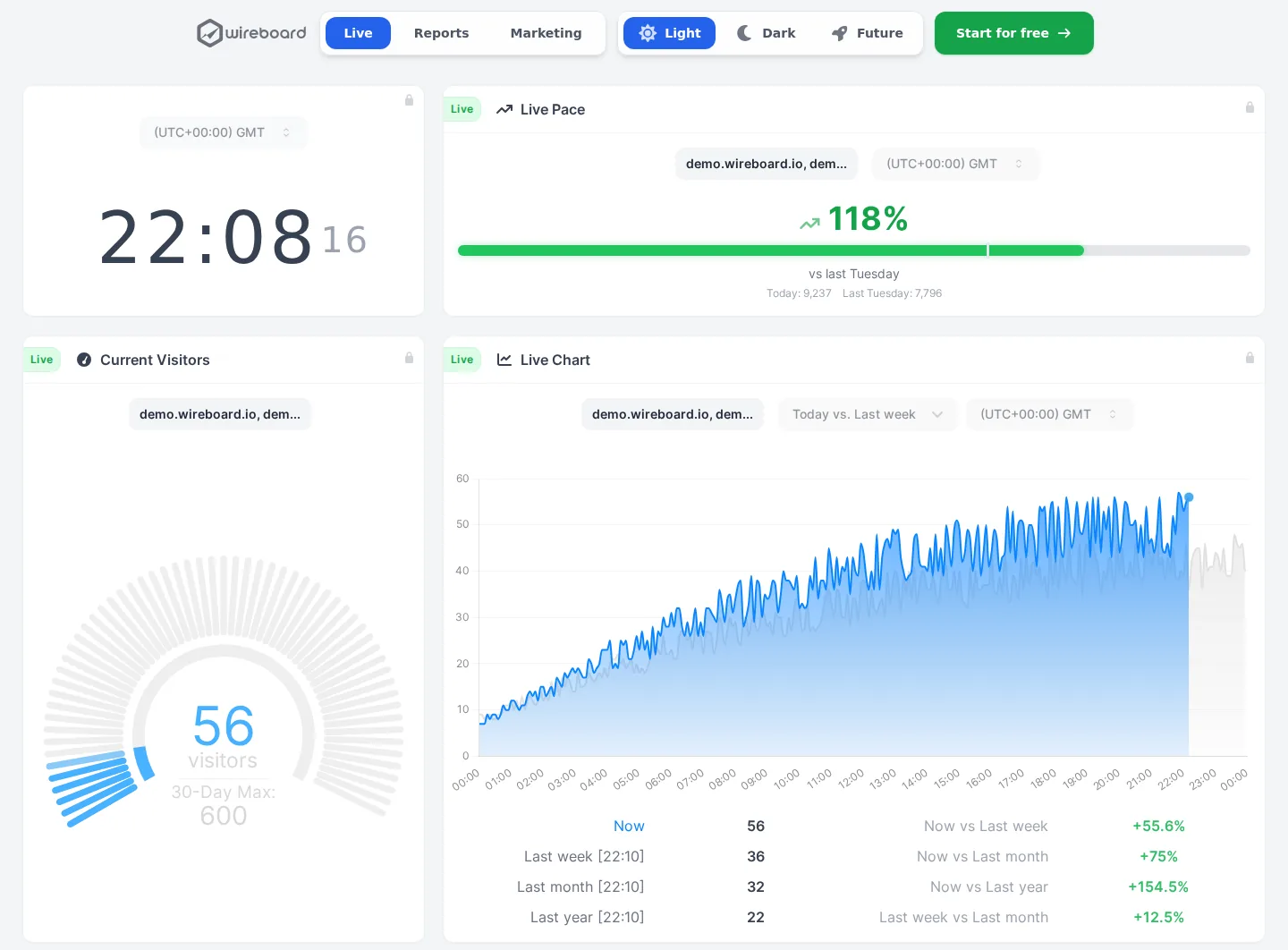
See your traffic as it happens, on live dashboards you build yourself. Nearly every feature is on the free plan.
- Visitors, sources and events streamed live
- Several sites in one view, on 60+ widgets
- Events, goals, funnels and revenue on every plan
- Free for 2 sites, $9 a month for 50
- Data processed in Germany and Finland
Which kind of tool do you need?
"Google Analytics alternative" covers very different products. A cookieless dashboard shows visitors, sources and pages on one screen. A heatmap tool shows what people do on a single page. Product analytics follows users through a sign-up flow. Pick the kind of tool before you pick the brand, starting from the question you need answered.
How many people visit, from where, and what do they read?
You need traffic analytics, a light script and one dashboard. Several of these tools set no cookies by default.
6 tools we review for this, with their score out of 5
What do people do on a page, and where do they give up?
You need heatmaps and session recordings, usually next to your traffic analytics rather than instead of it.
8 tools we review for this, with their score out of 5
Heatmap and session recording toolsWhich users adopt a feature, and who comes back?
You need product analytics, built around users and events rather than pages.
3 tools we review for this, with their score out of 5
Product analytics tools comparedWhich companies visit your B2B site?
That is lead identification. It tells you which companies visit, and it does not replace traffic analytics.
The tool we review for this, with its score out of 5
Do you need single sign-on, contracts and guaranteed uptime?
Look at the enterprise platforms, sold on contract with governance features.
6 tools we review for this, with their score out of 5
Enterprise web analytics platformsWhat to compare before you choose
We score every tool on the same seven criteria (how we review). Each one hides a practical question.
Features you will actually use. List the questions you ask every month, then check which plan answers them. Funnels are on Umami's free plan, on Plausible's Business plan and on Pirsch's Plus plan, and Fathom has none at any price.
Reports. Look at how you will read the data: filters you click, saved views, period comparisons, email reports, exports and an API. Matomo has segments on every report and custom reports; Simple Analytics keeps custom views and its export API for Enterprise.
Live data. "Real time" means very different things. WireBoard, made by SwissOps (which runs this site), streams visitors, pages, sources and events as they happen on every plan, and its live API (on paid plans) sends each change within about a second. Clicky's Spy updates every couple of seconds on paid plans, Matomo's visits log every 5 seconds, Plausible's live view every 30 seconds, and Fathom's current visitors panel in 5-minute intervals. Google says its Realtime report typically runs a few minutes behind. That gap matters on launch day or in a newsroom, much less on a blog. See the real-time shortlist.
Ease of setup. Nearly every tool starts with one script tag, but then they differ. Plausible, Fathom and Simple Analytics fit on one page anyone can read. Mixpanel and Heap need someone to plan or name events, and Adobe Analytics asks for a solution design before tagging.
Dashboards. Most simple tools give you one fixed page, and Plausible, Pirsch and Fathom have no custom dashboards. WireBoard goes furthest the other way: more than 60 widgets you drag and resize, and one dashboard can combine several sites. Umami's boards and Matomo's widget dashboards also let you build your own layout.
Privacy defaults. Plausible, Umami, Pirsch, Fathom and Simple Analytics set no cookies by default. Matomo and WireBoard set cookies until you switch to their cookieless modes.
Pricing, and how it grows. Compare the price at the traffic you expect in two years, and check what is counted: pageviews, events, hits or sessions. Check the number of sites too: WireBoard's $9 plan and Pirsch's Standard plan cover 50, and every Fathom plan at least 50, while Plausible's Starter plan covers one.
The right tool for your kind of site
The same tool can suit one site and frustrate the next. Here are seven common cases, what each usually needs, and the reviewed tools that fit, with what to watch. The full reviews end with what each tool does badly, which is often what decides.
A blog or content site
Needs: Visitors, sources and top pages, without a cookie banner if possible
WireBoard shows visitors, sources and top pages on live dashboards that update within seconds, with the data on servers in Germany and Finland. It is free for 50,000 pageviews a month on 2 sites, and $9 a month buys 100,000 on 50 sites. It is made by SwissOps, which runs this site, and sets cookies by default, with an optional cookieless mode. Plausible and Umami set no cookies. Plausible puts everything on one page from $9 a month for 10,000 pageviews on one site and imports your GA4 history, and Umami's free cloud plan covers 100,000 events on one site. Simple Analytics is free for 5 hobby sites.
An online shop
Needs: Revenue by campaign, the steps to checkout, and where buyers give up
WireBoard tracks custom events with properties, goals, funnels, revenue and journeys of up to 29 steps on every plan, the free one included, so checkout steps and revenue sit next to your traffic. It is made by SwissOps, which runs this site, and sets cookies by default, with an optional cookieless mode. Matomo adds product and order reports, heatmaps and A/B tests in its cloud plan from $26 a month, with cookies until you switch them off. Umami's free plan has funnels and revenue reports without cookies. Sealmetrics ties sales to campaigns without cookies, from €499 a month on yearly billing. With all four, tracked events count toward the quota.
A SaaS product or web app
Needs: Funnels, retention, and which users adopt a feature
WireBoard covers the funnel side of a product on every plan: custom events with up to 30 properties, goals, funnels, revenue and journeys of up to 29 steps, with a REST API, a live API on paid plans and scheduled exports to S3 or SFTP. It is made by SwissOps, which runs this site, and sets cookies by default. Mixpanel adds retention, cohorts and session replay. It is free up to 1 million events a month, then $140 a month at 1.5 million on monthly billing. Heap records every click from one snippet, so you can define events later and see them on past data. Its paid plans have no public price.
An agency or a company with many sites
Needs: Many sites on one account, and reports you can share with clients
In WireBoard a dashboard is not tied to one site, so one widget can add up the traffic of several sites, live. Each client can get its own dashboard behind a public link that needs no login. Email reports go out daily, weekly or monthly, and exports run on a schedule. $9 a month covers 100,000 pageviews on 50 sites, and above 12 million pageviews or 100 sites WireBoard quotes an Enterprise price. It is made by SwissOps, which runs this site, and sets cookies by default, with an optional cookieless mode. Pirsch's Standard plan covers 50 sites from $6 a month, and Plus adds white labelling for client dashboards. Fathom covers at least 50 sites on every plan, with data stored in the US. A plan's pageviews cover all its sites together.
A newsroom or a campaign-driven site
Needs: Live traffic, to see a spike while it is still happening
WireBoard's live widgets stream visitors, pages, sources and events as they happen on every plan, the free one included, and its live API (on paid plans) sends each change within about a second. More than 60 widgets you drag and resize make a screen for the office wall, and WireBoard says its concurrent visitor chart covers the whole day. There are no overage fees: at the limit, tracking pauses until the next month, so pick a plan sized for your busiest month. It is made by SwissOps, which runs this site, and sets cookies by default. Clicky's Spy, on paid plans, updates every couple of seconds, with data in the US. Matomo's visits log refreshes every 5 seconds.
A large organisation
Needs: Single sign-on, contracts, governance and years of history
For the live traffic of many sites, WireBoard combines them in one view, keeps the data on servers in Germany and Finland and 3 years of history on paid plans, exports on a schedule to S3 or SFTP, and quotes an Enterprise price above 12 million pageviews or 100 sites. It is made by SwissOps, which runs this site. Adobe Analytics offers deep segmentation, raw data feeds and 25 months of history, extendable to 10 years, but is sold by contract and needs specialists. Matomo can run on your own servers, and its Enterprise cloud plan adds single sign-on. Mixpanel offers EU data residency on every plan.
You only need a free tool
Needs: Useful numbers without a monthly bill
WireBoard's free plan covers 50,000 pageviews a month on 2 sites, with live dashboards, custom events, goals, funnels and email reports, and needs no card. It is made by SwissOps, which runs this site. The free plan shows the last 30 days, and WireBoard says older data unlocks when you upgrade. Umami's free cloud plan covers 100,000 events a month on one site, with 6 months of data and no cookies. Overtracking is free for 50,000 pageviews on unlimited sites, with data in France, but its help centre says data is deleted after 12 months. Plausible, Matomo and Umami are free to host yourself.
Privacy: what actually changes
A cookie keeps an ID in the visitor's browser, so a tool can tell that Monday's visitor came back on Thursday. In the EU, under Article 5(3) of the ePrivacy Directive, storing or reading information on a visitor's device is only allowed with consent, or when it is necessary for a few specific purposes the article lists. The European Data Protection Board points out that the rule covers "similar technologies", not only cookies, so moving the ID to local storage does not get around it.
"Cookieless" usually means the tool stores nothing on the device and recognises a visitor by a hash instead. Plausible builds it from the IP address, the browser and a salt it deletes every 24 hours. Fathom changes its salt at midnight UTC, and Pirsch adds the date and a salt for each site. Umami rotates its salt monthly by default. Simple Analytics keeps no identifier at all and counts unique pageviews instead. The price is accuracy: with most of these tools, a person who comes back another day counts again, and so does anyone who switches device.
Tools that set no cookies and store no personal data are designed to run without a consent banner for analytics. Whether your site needs a banner also depends on everything else it loads (ads, embeds, chat widgets) and on the law where you operate. In France, the CNIL accepts that audience measurement trackers, cookies included, can be used without consent when they only measure the site's own audience, produce anonymous statistics, are not combined with other data or passed on, and do not follow people across sites. It recommends a lifetime of about 13 months and keeping data for 25 months at most. The CNIL also says these rules may vary by country, and that most large audience measurement offerings do not qualify, whatever their configuration. None of this is legal advice: check with your own adviser.
Three questions matter more than any badge on a pricing page:
- Does it set cookies or other identifiers by default? Check the vendor's documentation, not its home page. Matomo sets a visitor ID kept 13 months and WireBoard one kept 2 years, until you switch to their cookieless modes.
- Where is the data stored? WireBoard, Plausible, Pirsch, Simple Analytics and Matomo Cloud keep it in the EU. Umami and Mixpanel let you pick a region. Fathom, Clicky and Crazy Egg store or process it in the US.
- Can you check? Plausible (AGPL v3), Umami (MIT) and Matomo (GPL v3) publish their code, so anyone can read what the script collects, and you can host them yourself (open-source shortlist). With closed tools, you rely on the vendor's word or an audit.
With a cookie
The first visit stores an ID in the browser. Every later visit sends it back.
- Mondayid a7f3c9
- Thursdayid a7f3c9
- Next weekid a7f3c9
1 visitor, 3 visits
Accurate returning visitors, but the ID is stored on the device, which usually needs consent in the EU.
Without cookies
Nothing is stored. The tool hashes the request with a key that changes every day.
- Mondayhash 3be1
- Thursdayhash 91cf
- Next weekhash d40a
3 visitors, 3 visits
Nothing stays on the device, but a person who comes back on another day counts again.
What it costs
What decides the bill as you grow is the unit the tool counts.
- Pageviews. WireBoard is free up to 50,000 a month and then $9 for 100,000 on 50 sites, with custom events counted in the same quota. Pirsch starts at $6 for 10,000 on 50 sites, Plausible at $9 for 10,000 on one site, and Fathom at $15 for 100,000. Clicky counts per day: its free plan allows 3,000 pageviews a day.
- Events or hits. Umami counts every event and each event property you save, and a Matomo hit is any tracked pageview, event, download, outlink, site search or content interaction. Mixpanel is free up to 1 million events, then $140 a month at 1.5 million on monthly billing.
- Sessions. Heatmap and product tools such as Contentsquare (formerly Hotjar) and Heap count sessions.
- Quote. Adobe Analytics and Heap's paid plans publish no price.
Among free plans, WireBoard's covers 50,000 pageviews on 2 sites with the last 30 days visible, Umami's 100,000 events on one site with 6 months of data, and Simple Analytics' 5 sites with 30 days of history and a badge. Self-hosting Plausible, Matomo or Umami is free if you run the server. See the free shortlist.
Yearly billing usually saves money: two months free at WireBoard, Plausible, Pirsch, Fathom, Simple Analytics and Matomo, 33% at Clicky, 20% at Contentsquare. Crazy Egg bills paid plans yearly only.
Check what happens at the limit. WireBoard and Crazy Egg pause tracking until the next month. Pirsch keeps collecting for five days, but its dashboard stops at the day you hit the limit. Heap keeps collecting but asks you to upgrade before you can view the data. Matomo and Woopra charge overage fees, and Umami's paid plans bill extra events. Every price side by side is on compare web analytics pricing.
How to switch without losing your history
A switch takes about a month, most of it waiting for enough data to compare. Start by saving what you already have, because only GA4 history is left: Universal Analytics properties are no longer accessible.
Export your reports. GA4 downloads a standard report as a PDF, a CSV file or a Google Sheet, and CSV and Sheets files hold up to 100,000 rows. Export the reports you compare year on year, such as traffic by month, sources and top pages.
Check the retention setting. Explorations and funnel reports only reach back 2 or 14 months, depending on the property's data retention setting. If you rely on an exploration, export its results now.
Link the BigQuery export for raw data. Standard GA4 properties can export raw events to BigQuery, up to 1 million a day. You can use BigQuery's free sandbox, but Google charges for use beyond its limits. Google says data starts flowing within 24 hours of linking, and its help pages describe no export of the days before, so link it early.
Import into the new tool. Plausible, Pirsch, Fathom and Simple Analytics import GA4 data, and Matomo Cloud includes an importer for Google Analytics data. What survives differs. Pirsch stores imported data as daily totals, so its filters do not work on it. Simple Analytics imports pageviews only. Fathom keeps imported figures out of its email reports, and Plausible's import skips ecommerce revenue, exit pages and scroll depth. WireBoard, which we make, has no import, so its charts start on the day you install it.
Step 1, Before you start
Save what Google Analytics will not keep
Export the reports you compare year on year, and link the BigQuery export if you want raw events. Explorations only reach back 2 or 14 months.
Step 2, Week 1
Install the new tool next to Google Analytics
Keep both running for about a month, and check the first visits in the new tool's live view.
Step 3, Week 1
Recreate your goals and events
Do it before you remove the old tag, and check that each one fires.
Step 4, Week 1
Import your Google Analytics history
Only some tools can. Plausible, Pirsch, Fathom and Simple Analytics import GA4 data, and Matomo Cloud has an importer. Check what each keeps: Pirsch stores daily totals, Simple Analytics pageviews only.
Step 5, Weeks 1 to 4
Compare the numbers
Expect them to differ. Cookieless tools count unique visitors differently, and Google Analytics misses visitors who refuse consent.
Step 6, Before you switch
Update your consent banner and privacy policy
Name the new tool, and say what it collects and where the data is stored.
Step 7, After a month
Remove the Google Analytics tag
Do it once the new numbers look right. Keep your exports.
Final thoughts
No tool fits every site. A blog needs one page of clear numbers, a shop needs revenue by campaign, a product team needs funnels and retention, and a newsroom needs to see a spike while it is happening. Start from the kind of tool, shortlist two or three from the ranking, and run your choice next to Google Analytics for a month before you remove anything. Prices change often: check them on the vendor's page before you buy, and see the news for this year's changes.
Questions
Is there a free alternative to Google Analytics?
Yes, several. WireBoard (made by SwissOps, which runs this site) is free for 50,000 pageviews a month on 2 sites, Umami's cloud for 100,000 events on one site, and Overtracking for 50,000 pageviews on unlimited sites. Simple Analytics is free for 5 hobby sites with 30 days of history, and Clicky for 3,000 pageviews a day. Plausible, Matomo and Umami are free to host yourself.
Which alternative is easiest to set up?
Plausible, Fathom and Simple Analytics score 5 out of 5 for ease of use in our reviews: one script tag and one page to read. WireBoard, Umami and Pirsch are close behind, at 4.5. Product analytics tools such as Mixpanel and Heap install as quickly, but take real learning: their reports only become useful once someone plans or names the events.
Can I use an alternative alongside Google Analytics?
Yes, and for the first month you should, because comparing the two shows whether your goals and events work in the new tool. Expect the numbers to differ: cookieless tools count unique visitors differently, and Google Analytics misses visitors who refuse consent. As long as the Google tag stays, so does its need for consent in the EU.
Do I still need a cookie banner?
It depends on everything your site loads and on the law where you operate. Tools that set no cookies and store no personal data, such as Plausible, Pirsch or Simple Analytics, are designed to run without a consent banner for analytics. But ads, embeds and chat widgets can still need one, and in the EU the consent rule covers similar technologies, not only cookies. Check with your own adviser.
Can I import my Google Analytics data?
Into some tools. Plausible, Pirsch, Fathom and Simple Analytics import GA4 data, and Matomo Cloud includes an importer for Google Analytics data. Each keeps something different: Pirsch stores daily totals, and Simple Analytics imports pageviews only. WireBoard has no import. Universal Analytics data is out of reach: Google removed access to those properties and their API from July 2024.
Why are my numbers different from Google Analytics?
Most cookieless tools recognise a visitor for a day or a month, so a person who comes back later counts again, and Simple Analytics keeps no identifier at all. Ad blockers block some scripts more than others. Google Analytics misses visitors who refuse consent unless it can model them, and Google says its data takes 24 to 48 hours to process. A gap is normal.
What should I export before I leave Google Analytics?
Start with the reports you compare year on year. GA4 downloads a report as a PDF, a CSV file or a Google Sheet, and CSV and Sheets files hold up to 100,000 rows. For raw events, link the BigQuery export early: Google says data starts flowing within 24 hours of linking. Explorations only reach back 2 or 14 months, depending on your retention setting.
What changed with the EU-US Data Privacy Framework?
In July 2023 the European Commission decided that personal data can flow freely from the EU to US companies that take part in the framework, and Google says Google LLC has certified. In September 2025 the EU General Court dismissed an action to annul that decision. It does not settle cookie consent, which is a separate rule. This is not legal advice.
Shortlists by need
Sources
Facts about tools come from each review. The other facts in this guide come from these pages.
- Google Analytics Help: Google Analytics 4 has replaced Universal Analytics
- Google Analytics Help: Data retention
- Google Analytics Help: Get started with Explorations
- Google Analytics Help: About data thresholds
- Google Analytics Help: Consent mode on websites and mobile apps
- Google Analytics Help: Behavioral modeling for consent mode
- Google Analytics Help: Share and export reports
- Google Analytics Help: BigQuery Export
- Google Analytics Help: Set up BigQuery Export
- European Data Protection Board: Guidelines 2/2023 on the technical scope of Article 5(3) of the ePrivacy Directive
- CNIL: Cookies : solutions pour les outils de mesure d'audience (in French)
- CNIL: Sheet n°16, Use analytics on your websites and applications
- CNIL: Annual report 2022 (in French)
- European Commission: EU-US data transfers
- Google: Data transfer frameworks
- Court of Justice of the European Union: Press release 106/25, Latombe v Commission (3 September 2025)