
Sealmetrics
Cookieless analytics and sales attribution for online stores, from Spain
Cookieless, EU-hosted analytics that ties sales to campaigns, with real exports, an API and documents your data protection officer can check. It costs €499 a month once the first million events are used, and it counts no unique visitors, so it only fits stores with a real ad budget.
- From €499 a month
- No cookies
- Hosted in Ireland
- Revenue by campaign
We make WireBoard, one of the tools we review. It is scored on the same criteria as every other tool. How we review
Who it suits
A good fit if
- You run an online store or a booking site and want to know which campaigns bring sales.
- Many of your visitors reject the cookie banner, and you want analytics that does not depend on it.
- Your data has to stay in the EU, and your data protection officer wants documents to check.
Look elsewhere if
- You run a blog or a small business site: €499 a month buys attribution you will not use.
- You need unique visitors, returning visitors or time on site.
- You want to watch who is on the site right now.
Scores
Above average on privacy. Below average on real-time data and pricing.
- Sealmetrics
- Average of the 18 tools we reviewed
Every tool is scored from 0 to 5 on the same seven criteria, and the overall score is their average. How we score
Why these scores
- Privacy4.0, average 3.2
- No cookies or stored IPs, and hosting in Ireland. The browser builds a device hash that is re-keyed daily on the server. Closed source and self-assessed, not certified.
- Reporting4.5, average 4.1
- Comparisons, saved segments, CSV and PDF export, email reports, an API, BigQuery and Looker Studio. Segments cover only country, device, browser and system.
- Ease of use4.0, average 3.8
- One script or a plugin, most sites done in minutes. Sales tracking needs a line of code or a store connector.
- Design4.0, average 3.9
- Clean cards and charts over nine fixed reports, with no custom dashboards.
- Features4.0, average 4.1
- Conversions, revenue, a fixed ecommerce funnel, product properties, segments, an API and store connectors. No unique visitors or time on site.
- Real-time data2.5, average 3.2
- Visits reach the reports within seconds, but the dashboard refreshes once a minute and shows no current visitors.
- Pricing1.5, average 3.6
- The first million events are free, once. After that, €499 a month on yearly billing.
Key facts
No cookies, no stored IPs and visitor data kept in Ireland, all documented. The gaps: no unique visitors and no live view.
- Price
- From €499 a month on yearly billing, for 5 million events, excluding VAT
- Free plan
- None as such: the first 1 million events are free, once
- Free trial
- No time limit and no card. The free million lasts until it is used up
- Cookies
- None: nothing stored on the device, no IP addresses kept
- Open source
- No
- Self-hosting
- No, cloud only
- Data stored in
- Dublin, Ireland
- Company based in
- Spain
- Live view
- None: the dashboard refreshes every 60 seconds
- Unique visitors
- Not measured: it counts sessions, which it calls entrances
- Data kept for
- Daily figures 24 months, hourly figures 90 days, on every plan
- Billing
- Yearly (ten months for twelve) or monthly
From Sealmetrics’s own site, checked on .
Pricing
The first million events cost nothing. After that, €499 a month is the floor.
€499a month on yearly billing, for 5 million events. The first million events are free.
Agentic
1 million events in total, once, with every Growth feature and documentation-only support
Free
Growth
5 million events a month, unlimited sites and users, email support. €599 a month billed monthly
€499 a month
Scale
15 million events a month, webhooks, audit logs, priority support and managed AI. €1,079 a month billed monthly
€899 a month
Enterprise
Unlimited events, isolated processing, a 99.9% uptime SLA and an account manager
On request
Prices exclude VAT. Yearly billing is paid upfront and costs ten months for twelve. Only human events count (pageviews, clicks, conversions), and there is no overage charge: two months in a row over the allowance can move you up a plan.
Our review
What you get
Sealmetrics is web analytics for sites that sell, mainly online stores, hotels and travel sites, from Sealmetrics S.L., near Barcelona. Nine reports cover the basics (overview, trends, pages, sources, countries, devices) and the money side: conversions, smaller steps such as add-to-cart (it calls them microconversions), product and basket details, and a funnel from product view to purchase. The sources report splits traffic into channels, sources, mediums, campaigns, terms, content and referrers, each with its conversions and revenue.
Revenue goes to the last click of the session, and Sealmetrics names that model instead of blending several: there is no multi-touch attribution and no lookback across sessions. You can group channels your own way and override how campaign tags are read.
LENS, an AI assistant, answers questions about your figures in plain language and writes weekly and monthly summaries. It runs with your own key for Anthropic, OpenAI, DeepSeek or Gemini, or with Sealmetrics' managed AI, an add-on on Growth at €299 a month billed yearly, and included on Scale.
What it leaves out matters as much. Sealmetrics counts entrances (sessions), not people. It does not measure unique visitors or time on site, and it cannot connect one visit to the next, so there are no returning visitors, cohorts or user journeys. Its home page says plainly that it is not "a per-user tool".
Who it is for
Sealmetrics suits online stores, booking sites and lead-generation sites that spend real money on ads and want to know which campaigns bring sales, even when many visitors reject the cookie banner. It also suits teams whose data protection officer wants documents to check: Sealmetrics publishes a data processing agreement, a subprocessor list and self-assessments for France, Spain, Germany, the UK, Italy and Switzerland.
It does not suit blogs, brochure sites or small shops, for which €499 a month buys attribution they will not use. Look elsewhere too if you need unique or returning visitors, time on site, a live view of who is on the site, or conversions sent back to Google Ads or Meta: Sealmetrics sends none, and imports no ad spend.
Setting it up
One script tag goes in the page head. It weighed about 1.1 KB compressed when we checked, though Sealmetrics' how-it-works page says "under 5 KB". There is a Shopify app, a WordPress plugin and a WooCommerce plugin downloaded from the dashboard, modules for Magento, PrestaShop, OpenCart, Drupal and Joomla, packages for Next.js, React and Nuxt, and a Google Tag Manager template. An optional first-party subdomain serves the script from your own domain.
Sealmetrics' quick start says setup takes "under five minutes", while its platforms page says 5 to 30 minutes depending on the platform. Sales need one more call in your checkout, or a store connector. On Shopify, purchases are confirmed on the server by Shopify's order webhook. The "last hit" time at the top of the dashboard updates within seconds of the first tracked visit.
The vendor plans a week of checking: compare the first days with your orders, line up purchases and 5 to 10 microconversions with your backend by day 5, and sign off the figures after a week. There is no import from Google Analytics. Sealmetrics says it "does not import GA4 history" and suggests exporting what you want to keep.
Reports and dashboards
The overview shows six cards (entrances, pageviews, pages per entrance, bounce rate, conversions and revenue), a trend chart and the top landing pages and sources, refreshed every 60 seconds. You can compare a period with the one before, with last year or with custom dates.
A segment panel filters every report by country, device type, browser and operating system, and each table has its own filters. Saved segments live in your browser's local storage, so they do not follow you to another computer or to a colleague. Every report except the overview exports to CSV or PDF.
The funnel is fixed: entrances, product views, add to cart, checkout and purchase. It is built from event totals rather than single visitors, so product views can outnumber entrances. You cannot define your own steps in the dashboard, only through the API.
Email reports go out daily, weekly or monthly to up to 20 people, with the sections you choose. Every plan, the free allowance included, can export to BigQuery hourly or daily. A Looker Studio connector exists but is not yet listed in Google's gallery, so support has to enable your account. The REST API comes with a Python SDK, and a hosted MCP server lets AI assistants query your data. Webhooks and audit logs need Scale.
There is no live view. The "last hit" dot turns green when a visit arrived in the last 5 minutes, and Sealmetrics says it "is not a count of active visitors".
Privacy and your data
Sealmetrics says its tracker writes no cookie and nothing else to the visitor's device, and that IP addresses are never stored. The country comes from the browser's time zone, not the IP address.
In September 2026 it corrected its privacy documentation. In the browser, the tracker hashes standard device characteristics (user agent, time zone, languages, screen, colour depth, a few display preferences, and the device's processor cores and memory) together with your site's ID, and Sealmetrics now calls that hash "a device fingerprint". On the server, the hash is re-keyed with a secret and a salt that changes daily and is then destroyed, so visits cannot be linked across days or sites. Since August 2026 it no longer stores ad click IDs or full browser strings. It does not honour Global Privacy Control or Do Not Track signals.
Sealmetrics says no consent banner is needed for its own analytics, based on self-assessments against the criteria of the French and Spanish regulators, and it calls Germany "an open question". Its security page says it does not claim ISO 27001 or SOC 2 certification.
Visitor data is processed and stored in Dublin, with Noraina Limited, an Irish company, as host. The managed AI runs at Scaleway in Paris, and Resend, a US company, sends service emails without visitor data. Daily figures and conversions are kept for 24 months, hourly figures for 90 days and the event log for one day. The code is closed.
Pricing in practice
Every account starts with 1 million events free, in total, with every Growth feature and documentation-only support. Only human interactions count (pageviews, clicks, conversions, form submissions, add-to-cart), and bots are filtered out. Prices exclude VAT, and yearly billing is paid upfront at ten months for twelve.
A small blog with 20,000 pageviews a month would use the free million in about four years, then face €499 a month.
A growing shop with 150,000 pageviews and 300,000 events a month uses the free million in about three months, then needs Growth: €499 a month billed yearly (€5,988 a year), or €599 billed monthly, for 5 million events, unlimited sites and users, and a 99% uptime SLA. Managed AI adds €299 a month billed yearly.
An agency running 30 store sites with 12 million events between them needs Scale, at €899 a month billed yearly or €1,079 monthly, for 15 million events, with webhooks, audit logs, priority support and managed AI included.
There is no overage charge, and collection never stops or samples. Sealmetrics emails you at 80% of the allowance, forgives one overage month a year, and moves a Growth account to Scale only after two months in a row over the allowance, with notice. Our pricing comparison shows how far this sits above most tools.
Alternatives to Sealmetrics
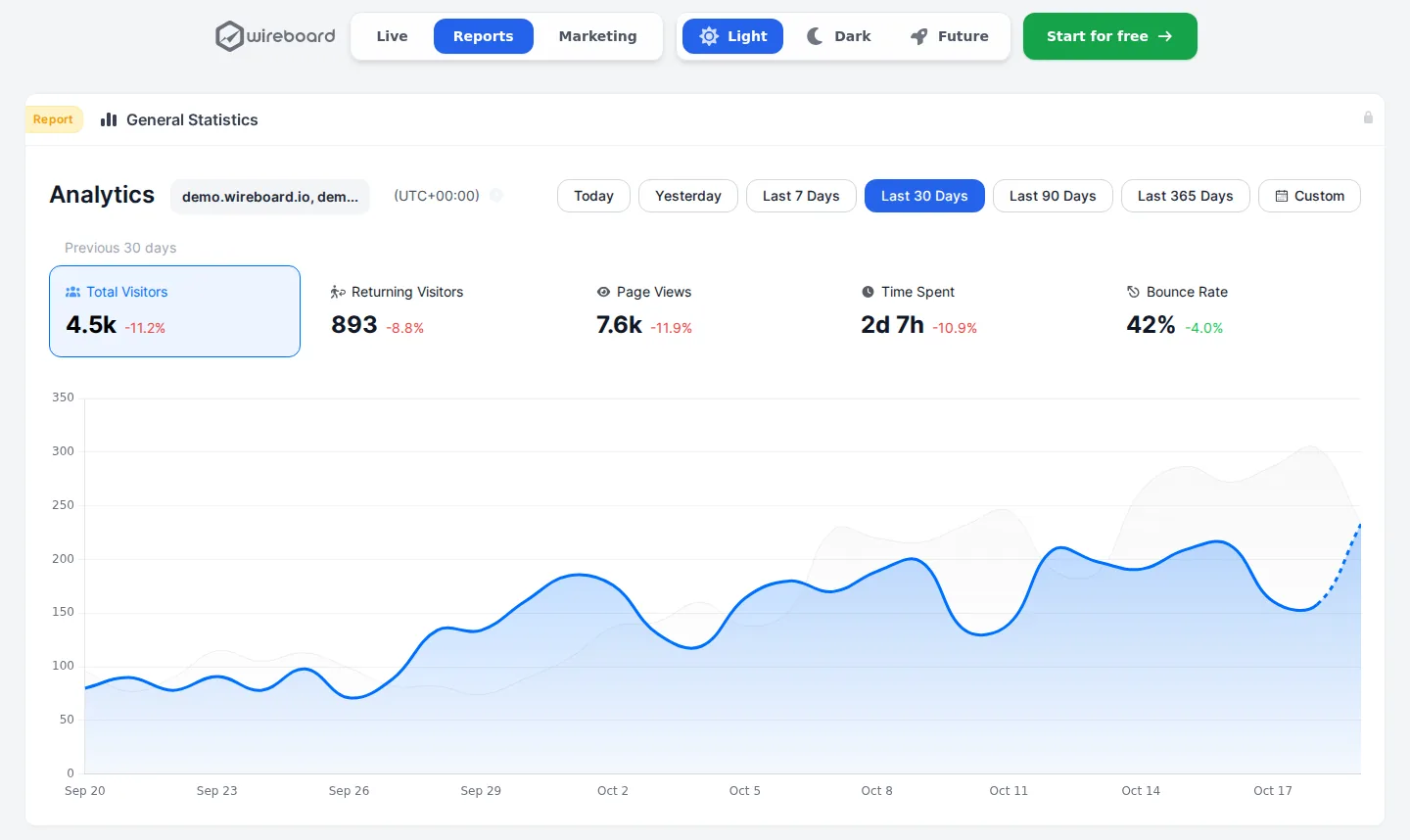
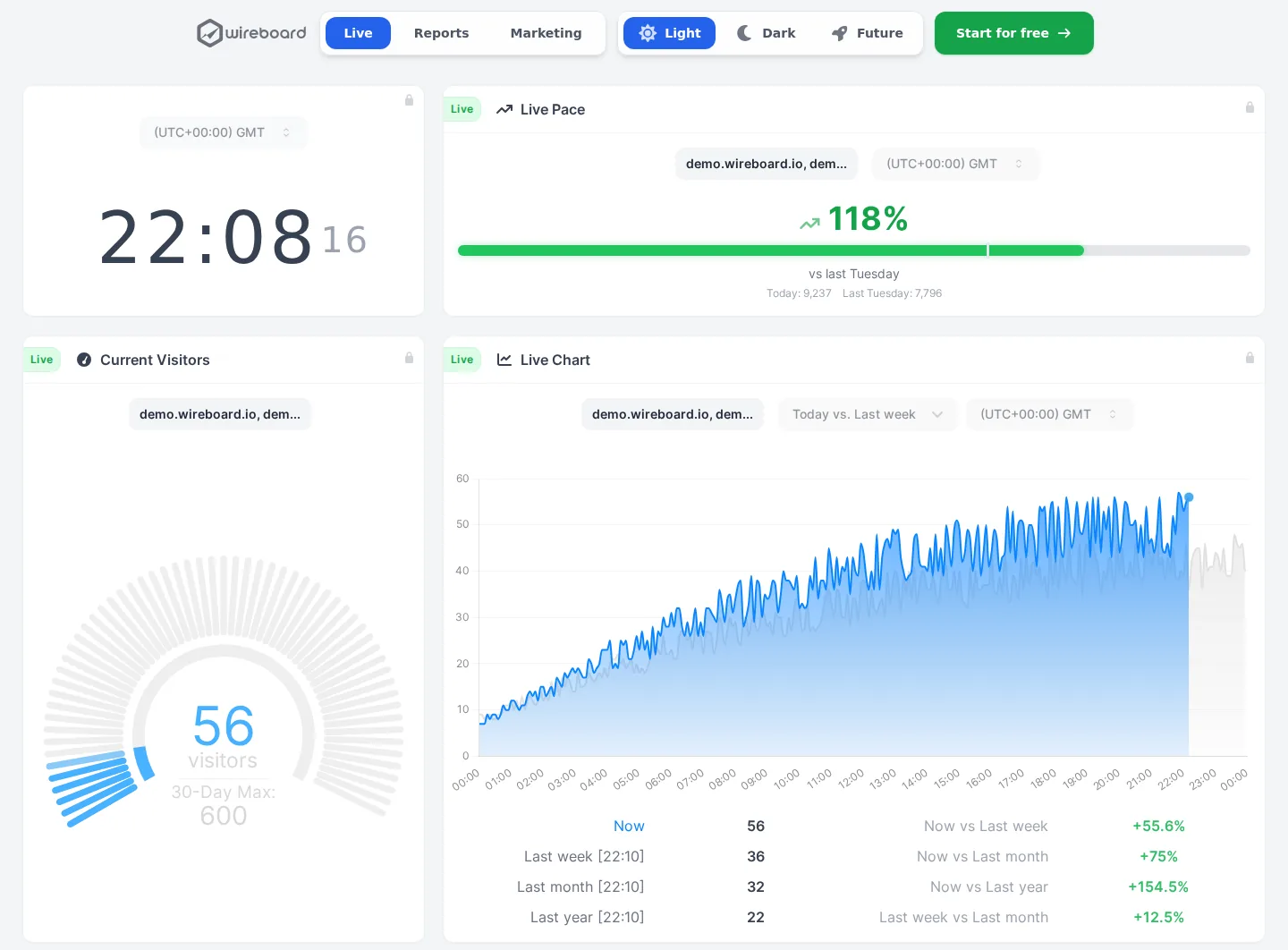
WireBoard (made by us) counts unique and returning visitors, tracks revenue, goals and funnels on every plan, and adds the live widgets Sealmetrics lacks. It is free for 2 sites, then $9 a month for 100,000 pageviews on 50 sites. It sets cookies by default, with an optional cookieless mode that stores nothing on the device.
Matomo covers ecommerce, funnels and multi-channel attribution, with a cookieless mode you switch on and cloud hosting in Frankfurt, from $26 a month. Self-hosting is free, with the premium features as paid plugins.
Pirsch is cookieless and hosted in Germany, with funnels and revenue on its Plus plan from $12 a month, and it counts unique visitors.
Google Analytics is free, links to Google Ads and exports to BigQuery, but sets cookies that generally need consent in the EU.
For larger set-ups, see our enterprise shortlist.
Where it falls short
Price is the main obstacle. The first million events come free once, and after that the cheapest plan is €499 a month on yearly billing, or €599 billed monthly.
There are no unique visitors, no time on site and no live view, which most site owners expect from any analytics tool. The funnel is fixed to an ecommerce path, and conversions do not flow back to Google Ads or Meta, so ad platforms keep optimising on their own numbers.
The privacy story has more nuance than the marketing. The home page promises no "stored fingerprints", while the docs now say the tracker builds a device fingerprint in the browser before it is re-keyed on the server. The consent position rests on Sealmetrics' own assessments.
Its pages also disagree in places. The home page says Growth covers 3 domains, while the pricing page says unlimited sites. The about page promises 99.99% uptime, while Growth's SLA is 99%. The pricing page says there is no time-limited trial, while the billing docs offer 14 days on paid plans. And going by its docs, the Shopify connector sends its checkout event under a name the funnel report does not count. Check the contract, and the funnel, before you sign.
How it compares
Plausible starts at $9 a month and Matomo's cloud at $26, and both count unique visitors. Sealmetrics only pays off if its revenue attribution changes how you spend on ads.
- Free plan
- Up to 50k pageviews
- Cookieless
- Optional
- Open source
- No
- EU hosting
- Yes
- Free plan
- Self-hosted only
- Cookieless
- Yes
- Open source
- Yes
- EU hosting
- Yes
- Free plan
- Self-hosted only
- Cookieless
- Optional
- Open source
- Yes
- EU hosting
- Yes
- Free plan
- 5 sites, 30 days of data
- Cookieless
- Yes
- Open source
- No
- EU hosting
- Yes
- Free plan
- Yes
- Cookieless
- No
- Open source
- No
- EU hosting
- No
Sealmetrics (this review)
Starts at €499 a month
3.5out of 5
- Free plan
- First 1M events only
- Cookieless
- Yes
- Open source
- No
- EU hosting
- Yes
- Free plan
- No
- Cookieless
- No
- Open source
- No
- EU hosting
- No





Made by us

WireBoard
See your traffic as it happens, on live dashboards you build yourself. Nearly every feature is on the free plan.
- Visitors, sources and events streamed live
- Several sites in one view, on 60+ widgets
- Events, goals, funnels and revenue on every plan
- Free for 2 sites, $9 a month for 50
- Data processed in Germany and Finland
Questions
Does Sealmetrics need a cookie banner?
Sealmetrics says it does not, for its own analytics. It sets no cookies, stores nothing on the visitor's device and keeps no IP addresses, though its tracker reads browser properties to build a session hash. That is its own assessment against the criteria of the French and Spanish regulators, not a certification, and it calls the question open in Germany. Everything else your site loads still counts.
Is Sealmetrics free?
Only at first. Every account starts with 1 million events free, in total, with every Growth feature and no card. The allowance never expires, but once it is used you move to Growth, at €499 a month on yearly billing or €599 billed monthly, excluding VAT. A small site can take years to use up the million.
Why are there no unique visitors?
Sealmetrics groups hits into sessions with an identifier that is re-keyed every day and cannot be rebuilt afterwards, so it never knows that two visits came from the same person. It reports entrances (sessions) instead, and no time on site. That is the price of storing nothing on the device. For returning visitors or cohorts, you need a second tool.
Do I have to remove Google Analytics?
No. Sealmetrics suggests running both side by side and comparing each with the orders your store recorded. In its case study of one Shopify store, GA4 missed 29% of visits over 48 days, while Sealmetrics recorded 96% of the store's real orders. Your own gap will differ, so compare against your own backend.
Where is Sealmetrics' data stored?
In Dublin, Ireland. Sealmetrics says visitor data is processed and stored there only, with Noraina Limited, an Irish company, as host. Its optional managed AI runs at Scaleway in Paris, and Resend, a US company, sends service emails that contain no visitor data. The company itself, Sealmetrics S.L., is based near Barcelona, Spain.
Can I import Google Analytics data into Sealmetrics?
No. Sealmetrics' migration guide says it "does not import GA4 history", so its reports start on the day you install the script. It suggests exporting what you want to keep before you switch, raw events through Google's BigQuery export and reports as CSV files. Keep your Google Analytics property open if you need to look back.
Does Sealmetrics show live visitors?
No. Visits reach the reports within seconds and the overview refreshes every 60 seconds, but there is no count of who is on the site now. The "last hit" indicator only shows when the latest visit arrived, turning green if it came in the last 5 minutes. Sealmetrics says plainly that it "is not a count of active visitors".
Sealmetrics or Matomo?
Both keep data in the EU and tie revenue to campaigns. Matomo counts unique visitors, offers heatmaps, A/B tests and a free self-hosted edition, and its cloud starts at $26 a month, but it sets cookies until you switch them off. Sealmetrics is cookieless by design and documents its consent position in detail, but costs €499 a month once the free million is used.
About this review
First published on . Facts and prices checked on against Sealmetrics’s own site.
Analytics Alternative is run by SwissOps, which also makes WireBoard, one of the tools on this site. WireBoard is scored on the same seven criteria as every other tool. How we review
Where the facts come from:
- sealmetrics.com/pricing
- sealmetrics.com/how-it-works
- sealmetrics.com/security
- sealmetrics.com/about
- sealmetrics.com/changelog
- docs.sealmetrics.com/reports
- docs.sealmetrics.com/reports/overview
- docs.sealmetrics.com/compliance/subprocessors
- sealmetrics.com/dpa
- sealmetrics.com/case-studies/incapto
- docs.sealmetrics.com/changelog
- docs.sealmetrics.com/reports/funnel
- docs.sealmetrics.com/reports/filters
- docs.sealmetrics.com/security-privacy/why-no-consent
- docs.sealmetrics.com/billing/usage-limits
- docs.sealmetrics.com/integrations/bigquery
Spotted something out of date? Tell us.