Smartlook is being retired. New sales ended on 31 May 2026 and renewals on 31 August 2026; the platform shuts down and deletes all data on 30 September 2027. It is no longer ranked. See the alternatives below.

Smartlook
Session recordings and event analytics from the Czech Republic, owned by Cisco and being retired
Smartlook pairs session recordings with events, funnels and heatmaps, for websites and mobile apps alike. It is no longer sold: renewals ended on 31 August 2026, and the platform shuts down on 30 September 2027.
- No longer sold
- Shuts down 30 Sept 2027
- Websites and mobile apps
- Masks forms by default
We make WireBoard, one of the tools we review. It is scored on the same criteria as every other tool. How we review
Who it suits
A good fit if
- You already pay for Smartlook and your plan still has months to run.
- You need time to export recordings and events before the shutdown.
- You are moving to Splunk Observability Cloud, where Cisco is rebuilding Smartlook's main features.
Look elsewhere if
- You are choosing a tool today: Smartlook takes no new subscriptions.
- You need your history long term: all data is deleted on 30 September 2027.
- You want to track visitors without cookies: it sets them by default and records sessions.
Scores
Below average on privacy and pricing.
- Smartlook
- Average of the 18 tools we reviewed
Every tool is scored from 0 to 5 on the same seven criteria, and the overall score is their average. How we score
Why these scores
- Real-time data3.5, average 3.2
- Smartlook says ongoing sessions show up in an Active sessions list moments after they start.
- Features4.0, average 4.1
- Recordings, events, funnels, heatmaps, user paths and app crash reports, with a REST API.
- Reporting4.0, average 4.1
- Saved segments, dashboards, scheduled email reports, CSV export and a REST API.
- Ease of use3.5, average 3.8
- A snippet or Google Tag Manager starts recording at once. Events, funnels and heatmaps take some setting up.
- Design3.5, average 3.9
- A clean, functional session list and player. New work now goes into Splunk's product instead.
- Privacy2.5, average 3.2
- Cookies and recordings by default, with forms and numbers masked. The EU region covers metadata, not all data.
- Pricing0.0, average 3.6
- Not for sale: no new subscriptions since 31 May 2026, and no renewals since 31 August 2026.
Key facts
Recordings, events and funnels for websites and apps, but no new customers and a shutdown on 30 September 2027.
- Status
- End of sale on 31 May 2026, end of renewals on 31 August 2026
- Shutdown
- Platform switched off and data deleted on 30 September 2027
- Price
- None published since the end of sale
- Free plan
- Paid accounts fall back to it until the shutdown
- Successor
- Digital Experience Analytics in Splunk Observability Cloud, with no data migration
- Cookies
- Yes by default. A setting moves them to local storage
- Open source
- No
- Self-hosting
- No
- Data stored in
- EU or US region for metadata. Smartlook does not promise all data stays there
- Owned by
- Cisco. Smartlook.com, s.r.o. is registered in Brno, Czech Republic
- Live view
- Active sessions appear moments after they start
- Platforms
- Websites and mobile apps
From Smartlook’s own site, checked on .
Pricing
There is nothing to buy. Existing paid plans run out, then fall back to Free until the shutdown.
Not soldno new subscriptions since 31 May 2026
Smartlook stopped selling new subscriptions on 31 May 2026 and stopped renewals on 31 August 2026. Paid plans run to their end date, then fall back to the Free plan until the platform shuts down on 30 September 2027.
Cisco points customers to Digital Experience Analytics in Splunk Observability Cloud, through their account manager. Smartlook data is not migrated, so export it through the REST API before 31 August 2027.
Our review
What you get until the shutdown
Smartlook is no longer sold. Cisco, which owns it, stopped new subscriptions on 31 May 2026, and renewals and upgrades on 31 August 2026. Every paid plan ends by 31 August 2027, the last day of support, and on 30 September 2027 the platform is switched off and all remaining data deleted. We covered the announcement on our news page.
Until then, existing customers keep what they paid for. Smartlook records sessions on websites and in mobile apps, and builds everything else from those recordings: events, funnels, heatmaps, behaviour flows that show the paths people take, and crash reports for apps. When a paid plan ends, the account drops to the Free plan, with its limits, until the shutdown.
Cisco is carrying the main features over to Digital Experience Analytics, part of Splunk Observability Cloud, which it says keeps session replay, heatmaps, funnels and journey maps. No history moves with them: Smartlook says Splunk will not migrate any data, and subscriptions do not transfer on their own.
Like other tools of its kind, Smartlook shows how people use a site rather than counting traffic, so it sits next to a traffic analytics tool instead of replacing one.
Who it is for now
Only existing customers. If your paid plan still has months to run, Smartlook keeps working as before, and there is no need to rip it out today. But every month of new data is data you will lose in September 2027, so the real question is not whether to leave but when.
Three groups should move soon. Teams that rely on history, such as year-on-year funnel comparisons, need a new tool collecting data well before the old one stops. Mobile app teams need time, because a new SDK means a new app release. And anyone whose plan ends early lands on the Free plan, whose limits the shutdown FAQ does not spell out.
Larger companies already on Splunk may find Digital Experience Analytics the natural next step. Smartlook tells customers to ask their account manager or its support team for access. Small sites will find self-serve tools with free plans elsewhere.
Setting it up and getting your data out
New accounts cannot be created, so this is about running what you have and leaving cleanly. Smartlook installs on websites with a snippet, a Google Tag Manager tag or an npm package, and in mobile apps with its SDK. Sessions appear a few minutes after the tracking code goes live, and are complete once the visitor leaves and Smartlook has processed the data.
Events are set up by picking an element on the page or typing a CSS selector. A heatmap needs at least 10 sessions before it shows anything. If your site has logins, an identify call attaches a user ID or email to the visitor, so you can pull up every session of one customer.
To leave, start with the export. Smartlook asks customers to copy their data through its REST API before their paid plan ends, and no later than 31 August 2027, and links guides on creating an API token and on the calls available. Segments also export to CSV, up to 1,000 users at a time. Then run the new tool alongside Smartlook for a few weeks, so the two overlap before you remove the old snippet.
Heatmaps, recordings and reports
The session list is where most work starts. You can filter sessions by page, location, technology, traffic source (including UTM tags), user and event, and save filters as segments. Links can open filtered lists directly, for example sessions with rage clicks or errors. Smartlook says ongoing sessions show up in an Active sessions list moments after they start, and move to completed sessions a few minutes after they end. The player has tabs for the replay, developer tools and page analytics, and you can share a session or add notes to it.
Funnels show where people drop out, and one click lists the recordings of the people who left. Heatmaps show clicks and scroll depth on a page, and behaviour flows draw the paths between pages or screens. Crash reports for apps come with the recording of the moments before the crash.
Events and funnels can be emailed daily, weekly or monthly, and heatmaps daily. A REST API opens up the rest.
Privacy and your data
Smartlook says it masks passwords, numbers and forms in all sessions by default, shown as asterisks in the player. Form recording can be switched on, but password fields are never recorded. IP addresses are not recorded by default either: sessions show the IP as anonymous unless you switch IP recording on, and once on, it cannot be switched off. A Privacy API masks other elements.
The web SDK keeps visitor and session metadata in cookies and local storage. A setting turns the cookies off, but the same data then sits in local storage instead. A session ends after 60 minutes, or after 15 minutes without activity.
You choose an EU or US region, though Smartlook says the region is where metadata is stored and "does not ensure that all user data is stored in this region". The code is closed, and there is no self-hosting. Smartlook.com, s.r.o. is registered in Brno, in the Czech Republic, and owned by Cisco.
Whatever retention your plan had, all remaining data is deleted on 30 September 2027. Until then, whether your site needs a cookie banner depends on everything it loads and on the law where you operate.
Pricing in practice
There is nothing to buy. Smartlook has published no prices since the end of sale, takes no new subscriptions and sells no renewals or upgrades. A paid plan runs to its end date, then falls back to Free until 30 September 2027.
The real cost is the replacement. Using the prices in our reviews: a site with up to 200,000 sessions a month can move to Contentsquare's free plan, with up to 10,000 replays and one month of history, or to Growth from $49 a month for 13 months of history. A product team that used Smartlook's events and funnels can start on Mixpanel's free plan, which covers 1 million events and 10,000 replays a month; past that, Growth costs $140 a month at 1.5 million events. A small site that wants traffic stats too can start on Crazy Egg's free plan, then pay $29 a month, billed yearly, for 50 recordings. Matomo's cloud starts at $26 a month for 50,000 hits, with 150 recordings.
Budget time as well as money: someone has to export the old data and rebuild events, funnels and segments in the new tool. Our pricing comparison lists what each tool costs.
Alternatives to Smartlook
Smartlook combined recordings with events and funnels, for websites and mobile apps, so pick the replacement by the half you used most.
Contentsquare (formerly Hotjar) is the closest self-serve swap for website recordings. Its free plan covers 200,000 sessions a month, captures replays for 5% of them (up to 10,000), and adds heatmaps, funnels and error tracking, with data stored in Ireland. Free keeps one month of history; Growth, from $49 a month, keeps 13 months and records every session up to 20,000 a month. Contentsquare also documents replay SDKs for Android and iOS apps.
Mixpanel is the closest match for Smartlook's events and funnels. Its free plan covers 1 million events and 10,000 session replays a month, with heatmaps, funnels and retention, and it has SDKs for mobile apps. Data can stay in the EU if you choose that when you create a project, and it sets a 365-day cookie by default.
Crazy Egg suits a small site that mostly used heatmaps. Its free plan has traffic analytics, a live feed and Instant Heatmaps for up to 1,000 sessions a day. Recordings start at $29 a month, billed yearly, with 50 a month, and data is processed in the US.
Matomo suits a team that wants recordings inside full web analytics, hosted in Frankfurt on its cloud or on its own server. The cloud starts at $26 a month with 150 recordings a month, so check the quota against your traffic.
Whichever you pick, export your Smartlook data first, and compare the limits on our heatmaps shortlist. If you also want to watch traffic as it happens, WireBoard (made by us) streams live visitors, sources and events across several sites, with a free plan for 2 sites. It covers the traffic side, so run it next to one of the tools above.
Where it falls short
The main weakness is that it is ending. You cannot buy it, contracts cannot be renewed, and everything stored in it will be deleted on 30 September 2027. Support stops a month earlier, on 31 August 2027.
Its successor is not a like-for-like swap either. Digital Experience Analytics sits inside Splunk's observability platform, starts without your Smartlook history, and needs a conversation with an account manager rather than a sign-up form.
Even before the end, Smartlook needed care: cookies by default, recordings of every session, and an EU region that covers metadata rather than all data. Anyone still using it should export what they need and choose a replacement well before 2027.
How it compares
Contentsquare (formerly Hotjar) and Crazy Egg still sell heatmaps and recordings, and both have free plans.
- Free plan
- Up to 50k pageviews
- Cookieless
- Optional
- Open source
- No
- EU hosting
- Yes
- Free plan
- Up to 1M events a month
- Cookieless
- No
- Open source
- No
- EU hosting
- Your choice
- Free plan
- Self-hosted only
- Cookieless
- Optional
- Open source
- Yes
- EU hosting
- Yes
- Free plan
- Yes, without recordings
- Cookieless
- No
- Open source
- No
- EU hosting
- No
- Free plan
- Up to 10k sessions a month
- Cookieless
- No
- Open source
- No
- EU hosting
- Your choice
- Free plan
- Up to 200k sessions
- Cookieless
- Optional
- Open source
- No
- EU hosting
- Yes
Smartlook (this review)
Starts at Not sold
3.0out of 5
- Free plan
- Being retired
- Cookieless
- Optional
- Open source
- No
- EU hosting
- Your choice




Made by us

WireBoard
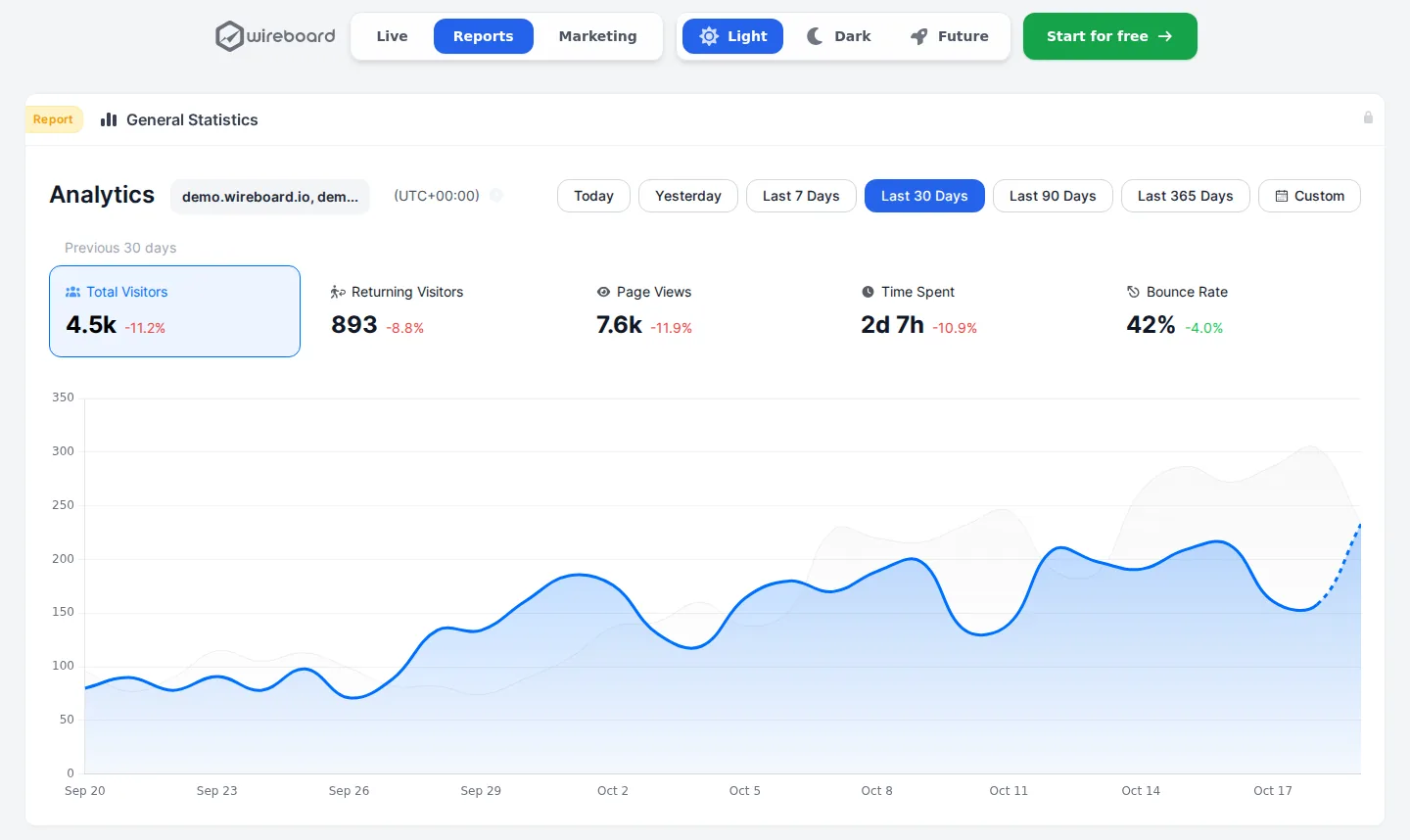
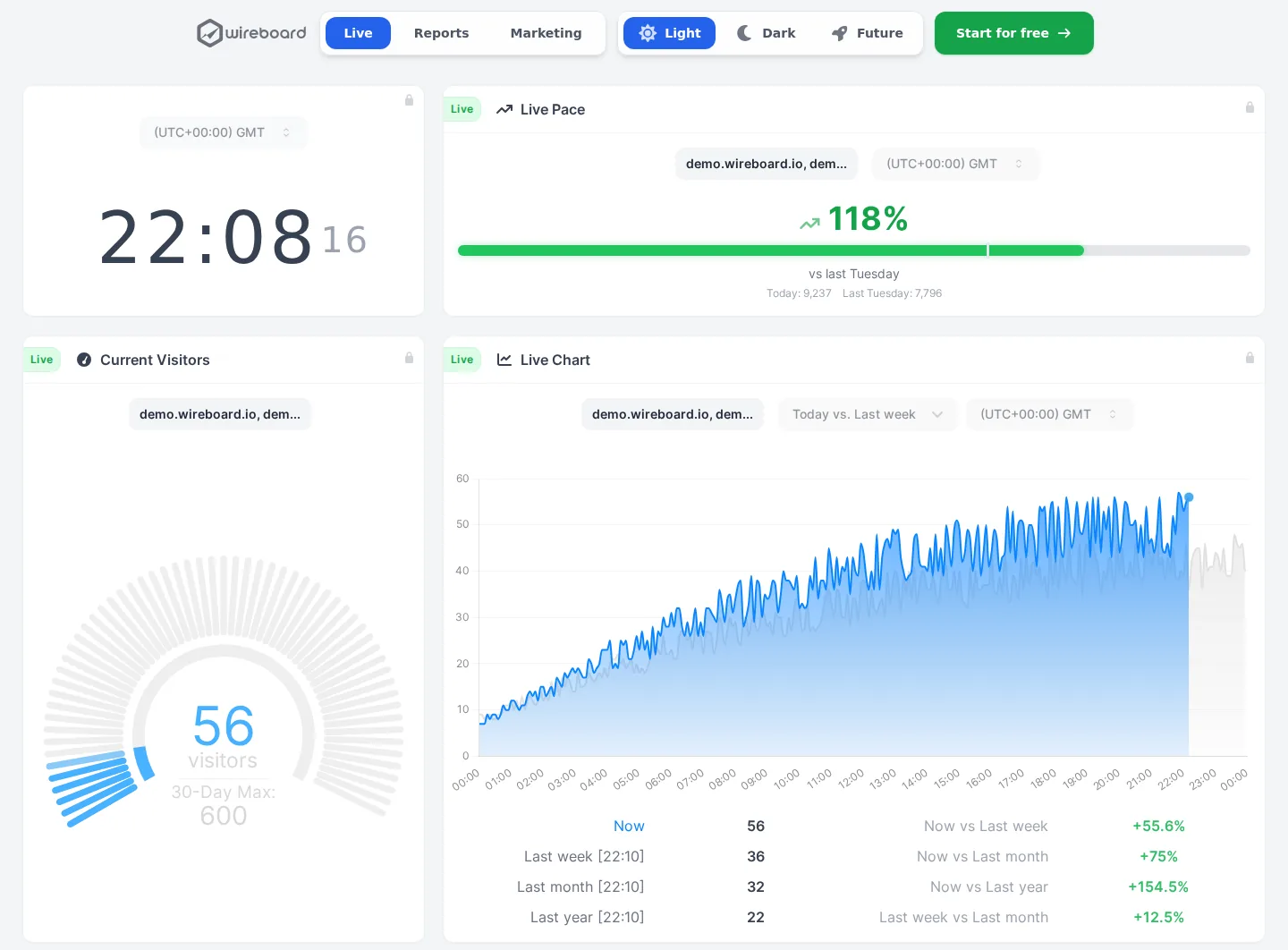
See your traffic as it happens, on live dashboards you build yourself. Nearly every feature is on the free plan.
- Visitors, sources and events streamed live
- Several sites in one view, on 60+ widgets
- Events, goals, funnels and revenue on every plan
- Free for 2 sites, $9 a month for 50
- Data processed in Germany and Finland
Questions
Is Smartlook shutting down?
Yes. Smartlook's home page lists the dates. New sales ended on 31 May 2026 and renewals on 31 August 2026. Every paid subscription ends by 31 August 2027, the last day of support, and on 30 September 2027 the platform is switched off and all remaining data deleted.
Can I still sign up for Smartlook?
No. Smartlook has sold no new subscriptions since 31 May 2026, and its home page now offers a login button and a FAQ about the shutdown, with no prices and no sign-up. Existing customers can keep using a paid plan until it ends, then the Free plan until 30 September 2027.
What happens to my Smartlook data?
It is deleted. On 30 September 2027 the platform is switched off and all remaining data goes with it. Splunk will not move Smartlook history into Digital Experience Analytics, so anything you want to keep has to be exported first, ideally before your paid plan ends.
How do I export my Smartlook data?
Smartlook points customers to its REST API, with guides on creating an API token and a list of the available calls, and to its reports and exports. Segments can also be exported to CSV, up to 1,000 users at a time. Smartlook recommends exporting before your paid subscription ends, and no later than 31 August 2027.
What replaces Smartlook?
Cisco points customers to Digital Experience Analytics in Splunk Observability Cloud, which it says carries on session replay, heatmaps, funnels and journey maps. Smartlook tells customers to ask their account manager or its support team for access. For a self-serve tool with a free plan, look at Contentsquare (formerly Hotjar), Mixpanel or Crazy Egg.
Is there a free alternative to Smartlook?
Yes, several. Contentsquare (formerly Hotjar) covers 200,000 sessions a month for free, with replays of 5% of them, up to 10,000. Mixpanel's free plan includes 10,000 session replays and heatmaps next to events and funnels. Crazy Egg's free plan has traffic analytics and heatmaps, but recordings start at $29 a month, billed yearly.
Who owns Smartlook?
Cisco. Smartlook's terms describe Smartlook.com, s.r.o., a company registered in Brno in the Czech Republic, as a wholly owned subsidiary of Cisco Systems. Cisco is winding Smartlook down and carrying its main features into Digital Experience Analytics, part of Splunk Observability Cloud.
Does Smartlook need a cookie banner?
By default its web SDK keeps visitor and session metadata in cookies and local storage, and it records sessions, with passwords, numbers and forms masked. A setting turns the cookies off, but the data then sits in local storage instead. Whether your site needs a banner depends on everything it loads and on the law where you operate.
About this review
First published on . Facts and prices checked on against Smartlook’s own site.
Analytics Alternative is run by SwissOps, which also makes WireBoard, one of the tools on this site. WireBoard is scored on the same seven criteria as every other tool. How we review
Where the facts come from:
- smartlook.com
- help.smartlook.com/docs/terms-of-service
- help.smartlook.com/docs/terms-of-service-archived-26-september-2023
- help.smartlook.com/docs/smartlook-basics
- help.smartlook.com/docs/sessions-1
- help.smartlook.com/docs/reports
- help.smartlook.com/docs/recording-sensitive-data
- web.developer.smartlook.com/docs/sessions-and-users
- web.developer.smartlook.com/docs/getting-started
- web.developer.smartlook.com/reference/smartlookinit
Spotted something out of date? Tell us.